Ch. 2 - General Chemistry Translated: Finding the Electrons
Mullins - Organic Chemistry: A Learner Centered Approach 1st Edition
Mullins1st EditionOrganic Chemistry: A Learner Centered ApproachISBN: 9780137566471Not the one you use?Change textbook
Chapter 1, Problem 59b

Which atom in each pair would you expect to be the central atom in a Lewis structure?
(b) C vs. O

Verified step by step guidance
1
Identify the general rule for selecting a central atom in a Lewis structure: The central atom is typically the least electronegative element, as it is more likely to share its electrons and form bonds with surrounding atoms.
Compare the electronegativities of carbon (C) and oxygen (O). Carbon has an electronegativity of approximately 2.5, while oxygen has a higher electronegativity of approximately 3.5.
Since carbon is less electronegative than oxygen, it is more likely to serve as the central atom in a Lewis structure.
Consider the bonding capacity of each atom. Carbon typically forms four bonds (due to its four valence electrons), making it well-suited to act as a central atom. Oxygen, on the other hand, typically forms two bonds.
Conclude that carbon (C) is the preferred central atom in this pair when constructing a Lewis structure, based on its lower electronegativity and higher bonding capacity.

Verified video answer for a similar problem:

This video solution was recommended by our tutors as helpful for the problem above.
Video duration:
3m
Was this helpful?

Key Concepts

Here are the essential concepts you must grasp in order to answer the question correctly.

Lewis Structures

Lewis structures are diagrams that represent the bonding between atoms in a molecule and the lone pairs of electrons that may exist. They help visualize the arrangement of electrons and the connectivity of atoms, which is crucial for predicting molecular geometry and reactivity.
Recommended video:
Guided course
04:12
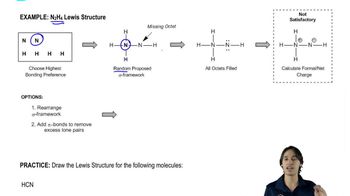
Drawing the Lewis Structure for N2H4.

Central Atom

The central atom in a Lewis structure is typically the atom that can form the most bonds or has the highest valence. It is usually the least electronegative element in a molecule, as it can effectively bond with surrounding atoms, allowing for a stable structure.
Recommended video:
Guided course
01:44
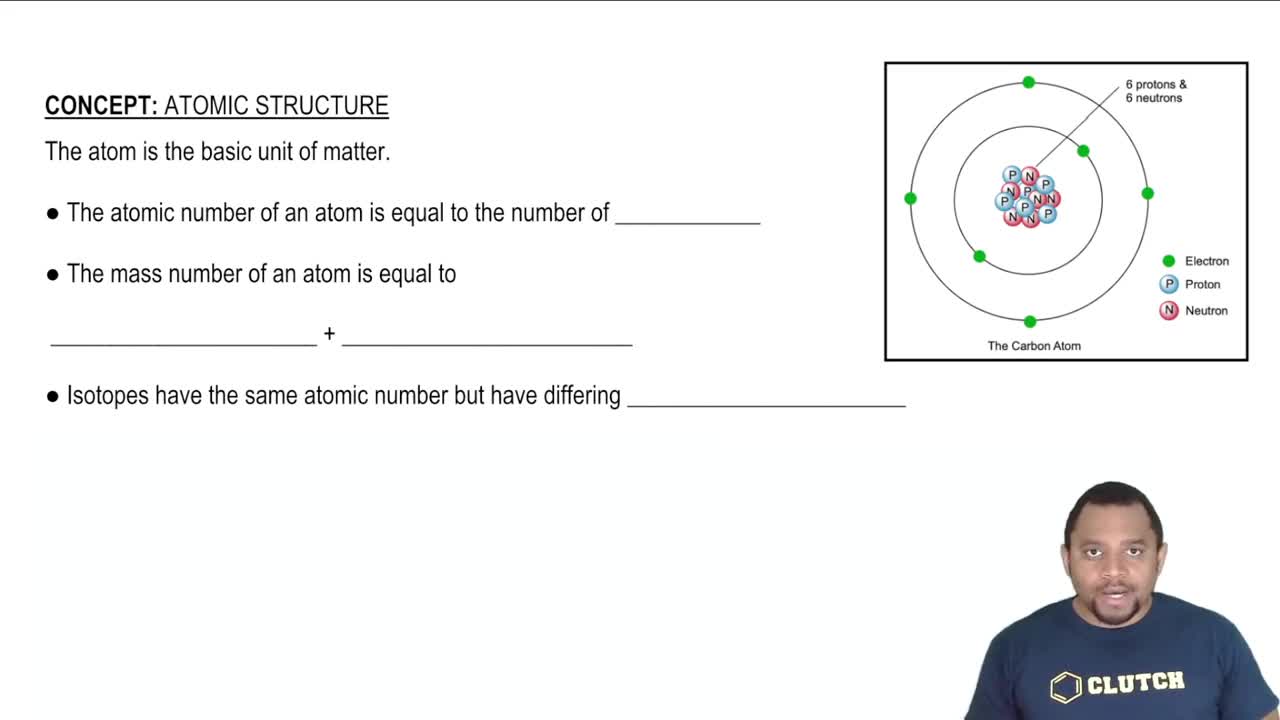
The difference between atomic numbers and atomic mass.

Electronegativity

Electronegativity is a measure of an atom's ability to attract and hold onto electrons in a chemical bond. In the context of determining the central atom, the atom with lower electronegativity is often preferred, as it is more likely to share its electrons and form bonds with other atoms.
Recommended video:
Guided course
1:47
Electronegativity