Ch. 2 - General Chemistry Translated: Finding the Electrons
Mullins - Organic Chemistry: A Learner Centered Approach 1st Edition
Mullins1st EditionOrganic Chemistry: A Learner Centered ApproachISBN: 9780137566471Not the one you use?Change textbook
Chapter 1, Problem 60e

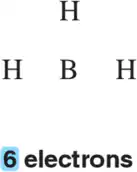
Given the atoms involved and the number of valence electrons remaining, complete the Lewis structure by placing bonds between atoms such that each has a full octet.
(e) Lewis structure diagram showing hydrogen and boron atoms with six valence electrons indicated below.

Verified step by step guidance
1
Step 1: Identify the central atom in the molecule. Typically, the least electronegative atom (excluding hydrogen) is chosen as the central atom. Arrange the other atoms around it.
Step 2: Determine the total number of valence electrons available for the molecule. Add up the valence electrons of all atoms involved. For this problem, you are given 6 electrons.
Step 3: Place single bonds between the central atom and surrounding atoms. Each bond uses 2 electrons. Subtract the electrons used for bonding from the total valence electrons.
Step 4: Distribute the remaining electrons as lone pairs around the surrounding atoms to complete their octets. If there are still electrons left, place them on the central atom as lone pairs.
Step 5: Check the structure to ensure all atoms (except hydrogen) have a full octet and that the total number of electrons used matches the given number of valence electrons (6 electrons). Adjust bonds if necessary, such as forming double or triple bonds to satisfy the octet rule.

Verified video answer for a similar problem:

This video solution was recommended by our tutors as helpful for the problem above.
Video duration:
2m
Was this helpful?

Key Concepts

Here are the essential concepts you must grasp in order to answer the question correctly.

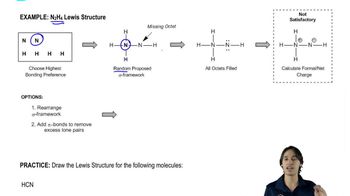
Lewis Structures

Lewis structures are diagrams that represent the bonding between atoms in a molecule and the lone pairs of electrons that may exist. They use dots to represent valence electrons and lines to represent bonds between atoms. Understanding how to draw Lewis structures is essential for visualizing molecular geometry and predicting the reactivity of compounds.
Recommended video:
Guided course
04:12
Drawing the Lewis Structure for N2H4.

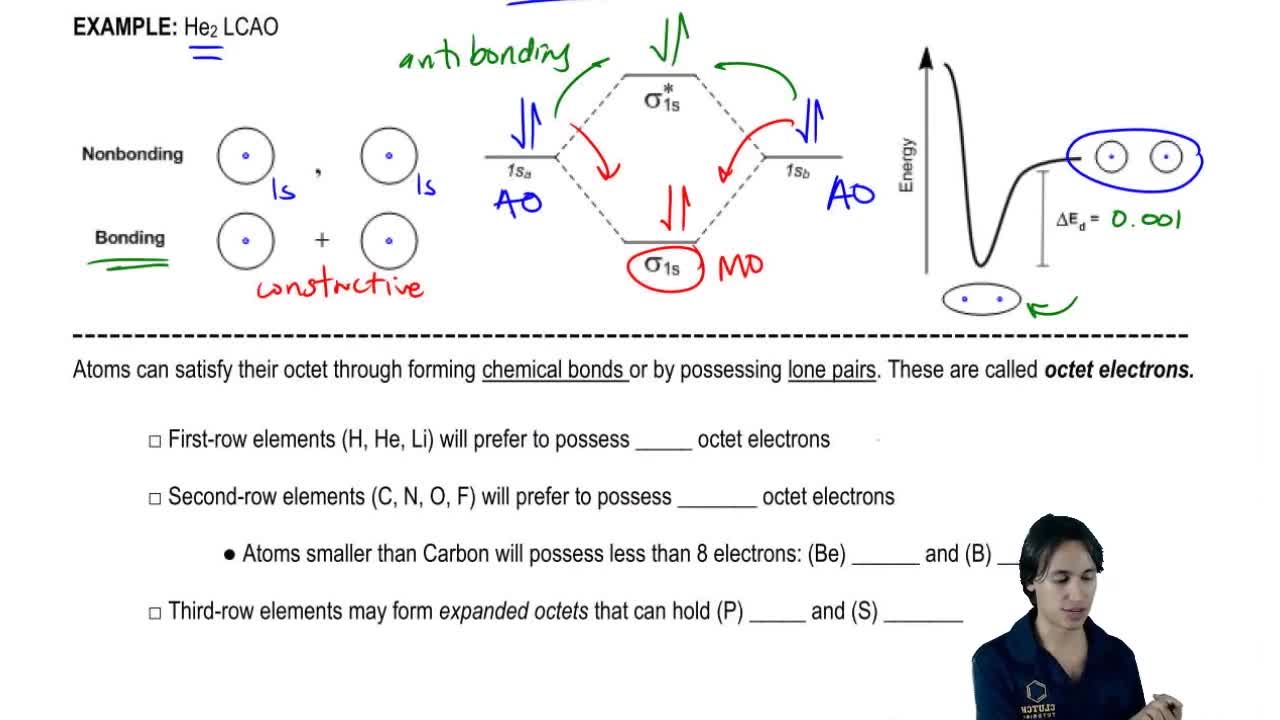
Octet Rule

The octet rule is a chemical rule of thumb that states that atoms tend to bond in such a way that they each have eight electrons in their valence shell, achieving a stable electron configuration similar to that of noble gases. This rule is particularly applicable to main group elements and is crucial for determining how atoms will bond in a molecule.
Recommended video:
Guided course
02:59
The octet rule.

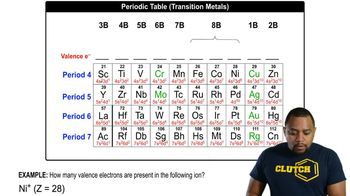
Valence Electrons

Valence electrons are the electrons in the outermost shell of an atom that are involved in forming bonds with other atoms. The number of valence electrons determines how an atom can bond and interact with others, making it a key factor in constructing Lewis structures and understanding molecular stability.
Recommended video:
Guided course
03:40
Valence Electrons of Transition Metals