Ch. 19 - Nucleophilic Acyl Substitution II: Carboxylic Acid Derivatives
Mullins - Organic Chemistry: A Learner Centered Approach 1st Edition
Mullins1st EditionOrganic Chemistry: A Learner Centered ApproachISBN: 9780137566471Not the one you use?Change textbook
Chapter 18, Problem 15

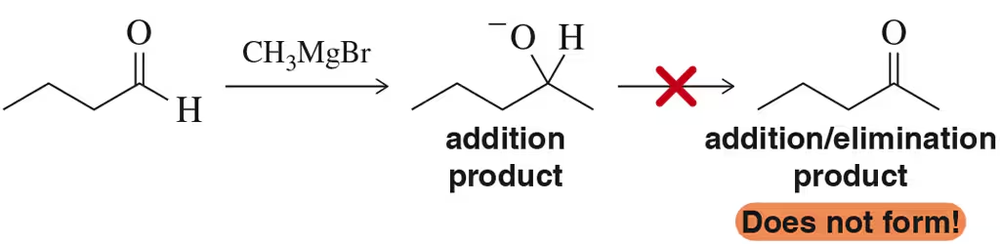
You might expect that aldehydes and ketones could undergo the addition/elimination mechanism. With strong nucleophiles, however, nucleophilic addition is the only outcome. Why?
Grignard reagent reacts with aldehyde to form alcohol; addition/elimination product does not form.

Verified step by step guidance
1
Understand the structure of aldehydes and ketones: Both contain a carbonyl group (C=O), where the carbon is electrophilic due to the polarization of the double bond.
Recognize the role of nucleophiles: Strong nucleophiles are species that donate an electron pair to form a bond with an electrophile. In the case of aldehydes and ketones, they target the electrophilic carbon in the carbonyl group.
Consider the mechanism of nucleophilic addition: When a strong nucleophile attacks the carbonyl carbon, it forms a tetrahedral intermediate. This intermediate is stable and does not favor elimination because the carbonyl oxygen can accommodate the negative charge.
Evaluate the possibility of elimination: For elimination to occur, the leaving group must be able to depart, forming a stable product. In aldehydes and ketones, there is no good leaving group attached to the carbonyl carbon, making elimination unfavorable.
Conclude why addition is favored: The stability of the tetrahedral intermediate and the lack of a suitable leaving group in aldehydes and ketones make nucleophilic addition the predominant reaction pathway with strong nucleophiles.

Verified video answer for a similar problem:

This video solution was recommended by our tutors as helpful for the problem above.
Was this helpful?

Key Concepts

Here are the essential concepts you must grasp in order to answer the question correctly.

Nucleophilic Addition

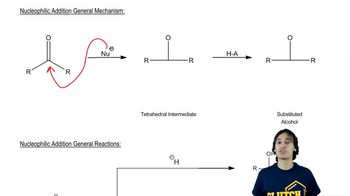
Nucleophilic addition involves a nucleophile attacking the electrophilic carbon of a carbonyl group, forming a tetrahedral intermediate. In aldehydes and ketones, the carbonyl carbon is highly electrophilic due to the polarization of the C=O bond, making it susceptible to nucleophilic attack. This reaction is favored with strong nucleophiles because they readily donate electrons to form a new bond with the carbonyl carbon.
Recommended video:
Guided course
08:27
Nucleophilic Addition

Addition/Elimination Mechanism

The addition/elimination mechanism typically involves a nucleophile adding to a substrate, followed by the elimination of a leaving group, resulting in substitution. In the context of carbonyl compounds, this mechanism is less common because aldehydes and ketones lack a good leaving group attached to the carbonyl carbon, which is necessary for the elimination step to occur after nucleophilic addition.
Recommended video:
Guided course
05:39
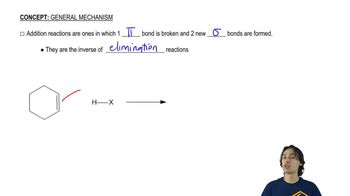
Features of Addition Mechanisms.

Role of Strong Nucleophiles

Strong nucleophiles are characterized by their high electron density and ability to form bonds quickly with electrophilic centers. In reactions with aldehydes and ketones, strong nucleophiles favor direct addition to the carbonyl carbon without subsequent elimination, as the carbonyl group does not have a suitable leaving group. This results in the formation of alcohols or other addition products rather than substitution products.
Recommended video:
Guided course
08:27
Nucleophilic Addition