Ch. 19 - Nucleophilic Acyl Substitution II: Carboxylic Acid Derivatives
Mullins - Organic Chemistry: A Learner Centered Approach 1st Edition
Mullins1st EditionOrganic Chemistry: A Learner Centered ApproachISBN: 9780137566471Not the one you use?Change textbook
Chapter 18, Problem 48c

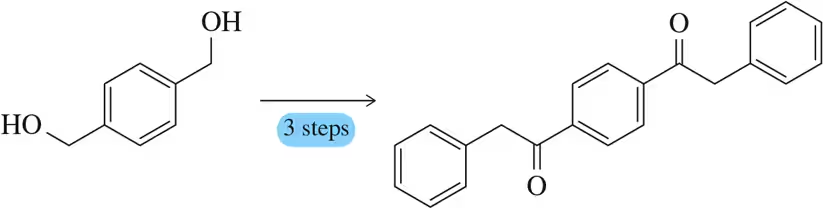
Suggest a series of steps involving a cuprate reagent that would convert the reactant on the left to the product on the right. The ideal number of steps is shown.
(c) Chemical reaction diagram showing a reactant with hydroxyl groups converting to a product in three steps using a cuprate reagent.

Verified step by step guidance
1
Step 1: Protect the phenol group on the reactant to prevent it from interfering in subsequent reactions. This can be done by converting the phenol to a silyl ether using a silyl chloride reagent such as TMSCl (trimethylsilyl chloride) in the presence of a base like imidazole.
Step 2: Perform a Friedel-Crafts acylation to introduce the acyl group onto the aromatic ring. Use an acyl chloride, such as benzoyl chloride, in the presence of a Lewis acid catalyst like AlCl3 to form the ketone on the aromatic ring.
Step 3: Use a cuprate reagent to perform a conjugate addition to the enone system. Prepare a Gilman reagent, such as lithium diphenylcuprate (Ph2CuLi), and add it to the enone to form the desired product with the phenyl group added to the beta position of the enone.
Step 4: Deprotect the silyl ether to regenerate the phenol group. This can be achieved by treating the compound with a fluoride source such as TBAF (tetrabutylammonium fluoride) to remove the silyl protecting group.
Step 5: Verify the structure of the final product to ensure that the desired transformations have been achieved, comparing it to the target structure to confirm the successful synthesis.

Verified video answer for a similar problem:

This video solution was recommended by our tutors as helpful for the problem above.
Was this helpful?

Key Concepts

Here are the essential concepts you must grasp in order to answer the question correctly.

Cuprate Reagents

Cuprate reagents, typically organocuprates like lithium diorganocopper, are powerful nucleophiles used in organic synthesis. They are formed by the reaction of an organolithium compound with copper(I) salts. Cuprates are particularly useful for performing nucleophilic additions to carbonyl compounds and for coupling reactions, allowing for the formation of carbon-carbon bonds.
Recommended video:

Nucleophilic Addition

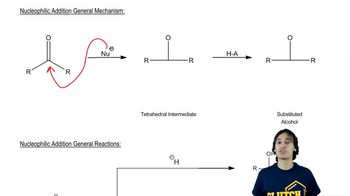
Nucleophilic addition is a fundamental reaction mechanism in organic chemistry where a nucleophile attacks an electrophilic carbon atom, typically in a carbonyl group. This process results in the formation of a new bond and often leads to the generation of alcohols or other functional groups. Understanding this mechanism is crucial for predicting the outcomes of reactions involving cuprate reagents.
Recommended video:
Guided course
08:27
Nucleophilic Addition

Reaction Mechanism Steps

A reaction mechanism outlines the step-by-step sequence of elementary reactions that occur during a chemical transformation. Each step involves the breaking and forming of bonds, and understanding these steps is essential for predicting the products and intermediates of a reaction. In the context of using cuprate reagents, knowing the specific steps helps in designing an efficient synthetic route to achieve the desired product.
Recommended video:
5:42
Step-Growth Polymers Concept 2