Ch. 19 - Nucleophilic Acyl Substitution II: Carboxylic Acid Derivatives
Mullins - Organic Chemistry: A Learner Centered Approach 1st Edition
Mullins1st EditionOrganic Chemistry: A Learner Centered ApproachISBN: 9780137566471Not the one you use?Change textbook
Chapter 18, Problem 36d

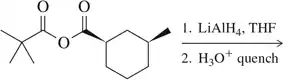
Predict the product of the following reductions.
(d) Chemical reaction diagram showing a reduction process with LiAlH4 and H3O+ quench, featuring carbonyl and alcohol groups.

Verified step by step guidance
1
Identify the functional groups present in the starting material. The compound contains an ester group, which is susceptible to reduction.
Recognize the reducing agent used in the reaction. Lithium aluminum hydride (LiAlH4) is a strong reducing agent capable of reducing esters to primary alcohols.
Understand the mechanism of reduction by LiAlH4. The hydride ion (H-) from LiAlH4 attacks the carbonyl carbon of the ester, leading to the formation of an alkoxide intermediate.
The alkoxide intermediate is then protonated during the aqueous workup (H3O+ quench) to form the corresponding alcohol.
Predict the product by considering the reduction of the ester group to a primary alcohol. The tert-butyl group and the cyclohexane ring remain unchanged in the product.

Verified video answer for a similar problem:

This video solution was recommended by our tutors as helpful for the problem above.
Was this helpful?

Key Concepts

Here are the essential concepts you must grasp in order to answer the question correctly.

Reduction Reactions

Reduction reactions in organic chemistry involve the gain of electrons or hydrogen, or the loss of oxygen by a molecule. These reactions typically convert carbonyl compounds, alkenes, or alkynes into alcohols or alkanes. Understanding the type of functional groups present in the substrate is crucial for predicting the outcome of the reduction.
Recommended video:
Guided course
07:12
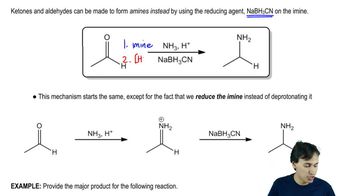
Reductive Amination

Common Reducing Agents

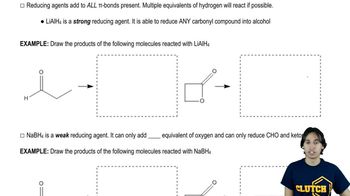
Common reducing agents include lithium aluminum hydride (LiAlH4), sodium borohydride (NaBH4), and hydrogen gas (H2) in the presence of a catalyst. Each reducing agent has specific reactivity and selectivity, influencing which functional groups can be reduced and to what extent. Knowing the properties of these agents helps in predicting the products of reduction reactions.
Recommended video:
Guided course
09:28
Reducing Agents

Stereochemistry of Reduction Products

The stereochemistry of reduction products is important, as reductions can lead to the formation of chiral centers. Depending on the substrate and the reducing agent used, the reaction may yield different stereoisomers. Understanding how the spatial arrangement of atoms affects the product is essential for predicting the outcome of reductions, especially in complex organic molecules.
Recommended video:
1:38
Polymer Stereochemistry Concept 1