Ch. 18 - Nucleophilic Acyl Substitution I: Carboxylic Acids
Mullins - Organic Chemistry: A Learner Centered Approach 1st Edition
Mullins1st EditionOrganic Chemistry: A Learner Centered ApproachISBN: 9780137566471Not the one you use?Change textbook
Chapter 17, Problem 69

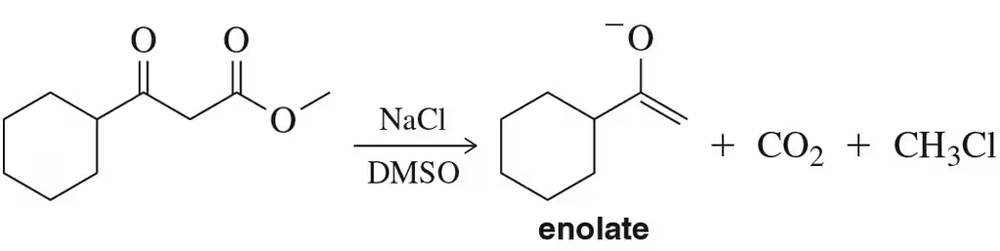
While acidic conditions were used in Assessment 18.68, decarboxylation of esters can also be conducted under basic conditions to give, at least temporarily, the enolate product shown. [We’ll learn more about the chemistry of enolates in Chapter 20.] Suggest a mechanism of this reaction. [Hint: The formation of chloromethane proceeds by an SN2 reaction.]
Chemical reaction diagram showing decarboxylation mechanism producing an enolate, carbon dioxide, and chloromethane.

Verified step by step guidance
1
Identify the starting ester compound and note that it is subjected to basic conditions using NaCl in DMSO.
Recognize that the reaction involves decarboxylation, which is the removal of a carboxyl group, releasing CO2.
Understand that under basic conditions, the ester is likely to form an enolate ion. The base (NaCl in DMSO) can deprotonate the alpha hydrogen adjacent to the carbonyl group, forming the enolate.
Consider the SN2 reaction mechanism for the formation of chloromethane (CH3Cl). The methoxide ion (CH3O-) can act as a leaving group, and the chloride ion (Cl-) from NaCl can perform a nucleophilic attack on the methyl group, resulting in the formation of CH3Cl.
Finally, the enolate ion is stabilized by resonance, and the decarboxylation process is completed with the release of CO2, resulting in the enolate product as shown in the reaction.

Verified video answer for a similar problem:

This video solution was recommended by our tutors as helpful for the problem above.
Video duration:
2m
Was this helpful?

Key Concepts

Here are the essential concepts you must grasp in order to answer the question correctly.

Decarboxylation

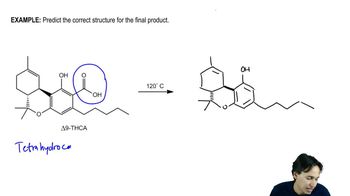
Decarboxylation is a chemical reaction that involves the removal of a carboxyl group (-COOH) from a molecule, resulting in the release of carbon dioxide (CO2). This process can occur under both acidic and basic conditions, leading to the formation of a more stable product, often an alkane or an enolate. Understanding the conditions and mechanisms of decarboxylation is crucial for predicting the outcome of reactions involving carboxylic acids and their derivatives.
Recommended video:
Guided course
02:32
Predict the correct structure

Enolate Formation

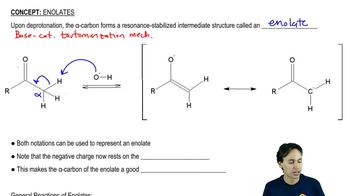
Enolates are reactive intermediates formed when a carbonyl compound, such as a ketone or aldehyde, is deprotonated at the alpha position. This results in a resonance-stabilized anion that can act as a nucleophile in various reactions. The formation of enolates is particularly important in organic synthesis, as they can participate in nucleophilic addition reactions and serve as intermediates in the synthesis of more complex molecules.
Recommended video:
Guided course
02:26
Formation of Enolates

SN2 Reaction Mechanism

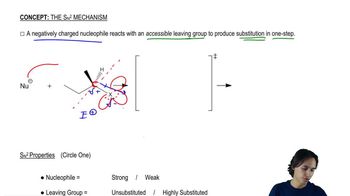
The SN2 (substitution nucleophilic bimolecular) reaction mechanism involves a nucleophile attacking an electrophile, resulting in the simultaneous displacement of a leaving group. This mechanism is characterized by a single concerted step, where bond formation and bond breaking occur simultaneously. The SN2 reaction is stereospecific and typically occurs with primary or secondary substrates, making it essential for understanding nucleophilic substitutions in organic chemistry.
Recommended video:
Guided course
08:33
Drawing the SN2 Mechanism