Ch. 18 - Nucleophilic Acyl Substitution I: Carboxylic Acids
Mullins - Organic Chemistry: A Learner Centered Approach 1st Edition
Mullins1st EditionOrganic Chemistry: A Learner Centered ApproachISBN: 9780137566471Not the one you use?Change textbook
Chapter 17, Problem 4

Calculate Keq for the acid–base reaction shown. Which side is favored and why?
Chemical equation showing an acid-base reaction with reactants and products, indicating equilibrium.

Verified step by step guidance
1
Step 1: Identify the acid and base on both sides of the reaction. On the left side, the acid is the molecule with the hydroxyl group (HO-CH2-CO-CH3), and the base is the ethoxide ion (CH3CH2O-). On the right side, the conjugate acid is ethanol (CH3CH2OH), and the conjugate base is the deprotonated form of the acid (CH2-CO-CH3).
Step 2: Determine the pKa values of the acid and conjugate acid. The pKa of the acid (HO-CH2-CO-CH3) is approximately 4.8, and the pKa of ethanol (CH3CH2OH) is approximately 16. This information is crucial for calculating the equilibrium constant (Keq).
Step 3: Use the relationship between pKa values and Keq. The equilibrium constant for an acid-base reaction can be calculated using the formula: \( K_{eq} = 10^{(pKa_{acid} - pKa_{conjugate acid})} \). Substitute the pKa values into this formula.
Step 4: Analyze which side of the reaction is favored. The side with the weaker acid (higher pKa) is favored because the reaction tends to favor the formation of the weaker acid and base. Compare the pKa values to determine this.
Step 5: Conclude why the favored side is determined. Since ethanol (pKa ~16) is a much weaker acid than HO-CH2-CO-CH3 (pKa ~4.8), the equilibrium will favor the side with ethanol and the conjugate base (CH2-CO-CH3).

Verified video answer for a similar problem:

This video solution was recommended by our tutors as helpful for the problem above.
Was this helpful?

Key Concepts

Here are the essential concepts you must grasp in order to answer the question correctly.

Acid-Base Equilibrium

Acid-base equilibrium refers to the balance between the reactants and products in an acid-base reaction. It is characterized by the transfer of protons (H+) from the acid to the base. The equilibrium constant, K_eq, quantifies this balance, indicating the extent to which reactants are converted to products. A larger K_eq value suggests that the products are favored, while a smaller value indicates that the reactants are favored.
Recommended video:
Guided course
04:00
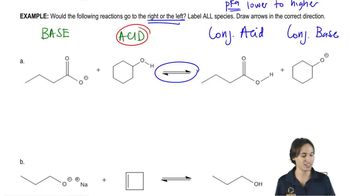
Determining Acid/Base Equilibrium

Strength of Acids and Bases

The strength of acids and bases is determined by their ability to donate or accept protons. Strong acids completely dissociate in solution, while weak acids only partially dissociate. Similarly, strong bases readily accept protons, whereas weak bases do so less effectively. Understanding the relative strengths of the acids and bases involved in the reaction is crucial for predicting the direction of the equilibrium and determining which side is favored.
Recommended video:
2:50
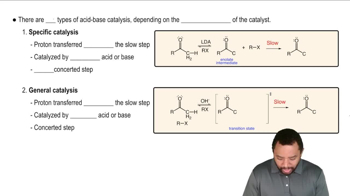
Acid-Base Catalysis Concept 3

Le Chatelier's Principle

Le Chatelier's Principle states that if a system at equilibrium is disturbed, the system will adjust to counteract the disturbance and restore a new equilibrium. In the context of acid-base reactions, if the concentration of either reactants or products changes, the equilibrium will shift towards the side that reduces the effect of that change. This principle helps in predicting how changes in concentration, pressure, or temperature will affect the position of equilibrium in acid-base reactions.
Recommended video:
Guided course
04:12
The Electron Configuration