Ch. 17 - Carbonyl Addition Reactions: Aldehydes and Ketones
Mullins - Organic Chemistry: A Learner Centered Approach 1st Edition
Mullins1st EditionOrganic Chemistry: A Learner Centered ApproachISBN: 9780137566471Not the one you use?Change textbook
Chapter 16, Problem 66c

Suggest a synthetic scheme, involving a protecting group, to generate the molecule shown starting with the molecule at the left.
(c) Synthetic scheme showing the conversion of a brominated molecule to a phenolic compound with a hydroxyl group.

Verified step by step guidance
1
Identify the functional groups in the starting material and the target molecule. The starting material has a bromo group and a ketone, while the target molecule has a hydroxyl group and a phenyl group added to the chain.
Consider the need for a protecting group. The ketone in the starting material might react during the synthesis, so it should be protected. A common protecting group for ketones is the acetal, which can be formed by reacting the ketone with a diol.
Plan the addition of the phenyl group. The bromo group can be replaced by a phenyl group through a nucleophilic substitution reaction, such as a Grignard reaction. First, convert the bromo group to a Grignard reagent by reacting it with magnesium in dry ether.
Perform the Grignard reaction. React the Grignard reagent with benzaldehyde to form the secondary alcohol. This step introduces the phenyl group and the hydroxyl group simultaneously.
Remove the protecting group. After the Grignard reaction, deprotect the ketone by hydrolyzing the acetal back to the ketone, completing the synthesis of the target molecule.

Verified video answer for a similar problem:

This video solution was recommended by our tutors as helpful for the problem above.
Video duration:
2m
Was this helpful?

Key Concepts

Here are the essential concepts you must grasp in order to answer the question correctly.

Protecting Groups

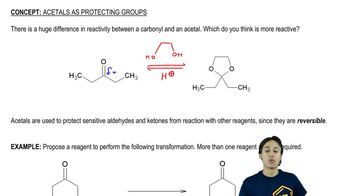
Protecting groups are chemical groups used in synthesis to temporarily mask a functional group to prevent it from reacting under certain conditions. They are crucial in multi-step synthesis to ensure that only the desired reactions occur. For example, hydroxyl groups can be protected as silyl ethers to prevent unwanted reactions during a synthesis sequence.
Recommended video:
Guided course
02:44
Protecting Groups

Nucleophilic Substitution Reactions

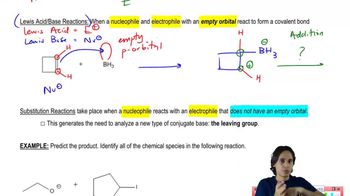
Nucleophilic substitution reactions involve the replacement of a leaving group, such as a halogen, by a nucleophile. In the context of the given reaction, the bromine atom can be replaced by a nucleophile, such as a phenyl group, through an SN2 mechanism, which is a one-step process where the nucleophile attacks the electrophilic carbon, displacing the leaving group.
Recommended video:
Guided course
01:47
Nucleophiles and Electrophiles can react in Substitution Reactions.

Grignard Reagents

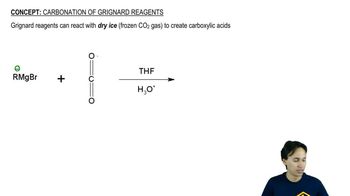
Grignard reagents are organomagnesium compounds used to form carbon-carbon bonds. They are typically prepared by reacting an alkyl or aryl halide with magnesium in an ether solvent. In the synthesis shown, a Grignard reagent could be used to introduce the phenyl group to the carbon chain, forming a new C-C bond and ultimately leading to the desired phenolic compound.
Recommended video:
Guided course
02:12
Carbonation of Grignard Reagents