Ch. 16 - Metals in Organic Chemistry
Mullins - Organic Chemistry: A Learner Centered Approach 1st Edition
Mullins1st EditionOrganic Chemistry: A Learner Centered ApproachISBN: 9780137566471Not the one you use?Change textbook
Chapter 15, Problem 22

To determine the stereochemistry of curacin A by synthesis, it would have been necessary to prepare all stereoisomers of the C₁₇―C₂₀ cyclopropane fragment. How would the reaction in Figure 16.30 be modified to produce the other stereoisomers shown here?
Structural representations of stereoisomers with specific configurations labeled as S and R.

Verified step by step guidance
1
Analyze the stereochemistry of the cyclopropane fragment in the given image. The stereoisomers are labeled as (S,R), (S,S), and (R,R), indicating the configurations of the two stereocenters in the cyclopropane ring.
To produce the other stereoisomers, consider the stereoselectivity and stereospecificity of the reaction. Stereoselectivity refers to the preference for forming one stereoisomer over another, while stereospecificity refers to the mechanism that leads to a specific stereoisomer based on the starting material.
Modify the reaction conditions to control the stereochemistry. For example, use chiral catalysts or reagents that can influence the stereochemical outcome of the reaction. This can help selectively produce one stereoisomer over another.
Adjust the starting materials to include enantiomerically pure or diastereomerically enriched compounds. This ensures that the reaction proceeds with a specific stereochemical pathway, leading to the desired stereoisomer.
Perform the reaction under conditions that allow inversion or retention of configuration at the stereocenters. For example, using specific solvents, temperatures, or additives can influence the stereochemical outcome and allow access to all stereoisomers of the cyclopropane fragment.

Verified video answer for a similar problem:

This video solution was recommended by our tutors as helpful for the problem above.
Video duration:
2m
Was this helpful?

Key Concepts

Here are the essential concepts you must grasp in order to answer the question correctly.

Stereochemistry

Stereochemistry is the study of the spatial arrangement of atoms in molecules and how this affects their chemical behavior. It encompasses concepts such as chirality, which refers to molecules that cannot be superimposed on their mirror images, leading to the existence of enantiomers. Understanding stereochemistry is crucial for predicting the reactivity and properties of organic compounds, especially in the context of synthesis and biological activity.
Recommended video:
1:38
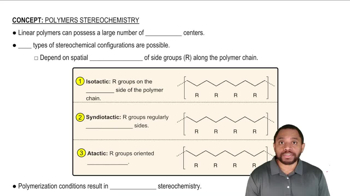
Polymer Stereochemistry Concept 1

Stereoselectivity

Stereoselectivity refers to the preference of a chemical reaction to produce one stereoisomer over others when multiple stereoisomers are possible. This concept is essential in organic synthesis, as it influences the yield and purity of the desired product. Reactions can be stereoselective due to factors such as steric hindrance or electronic effects, which can favor the formation of one stereoisomer over another.

Stereospecificity

Stereospecificity is a more stringent concept than stereoselectivity, indicating that a specific reactant will lead to a specific stereoisomer as the product. In stereospecific reactions, the configuration of the starting material directly determines the configuration of the product. This concept is vital for understanding how to modify reactions to achieve desired stereoisomers, particularly in complex organic syntheses like that of curacin A.
Recommended video:
Guided course
15:39
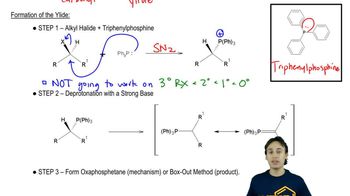
Box-Out Method and Full-Mechanism