Ch. 16 - Metals in Organic Chemistry
Mullins - Organic Chemistry: A Learner Centered Approach 1st Edition
Mullins1st EditionOrganic Chemistry: A Learner Centered ApproachISBN: 9780137566471Not the one you use?Change textbook
Chapter 15, Problem 7

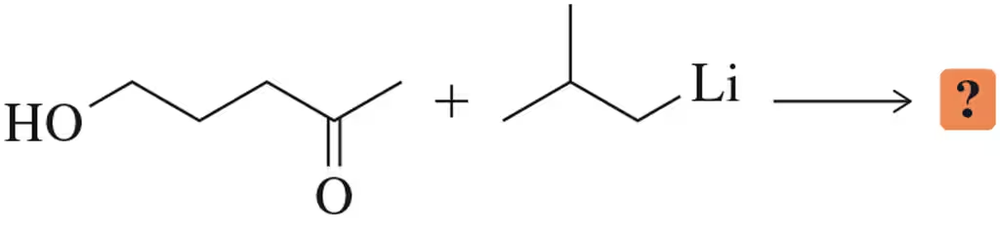
Predict the product that would result from the reaction of an organolithium reagent with a ketone when a hydroxyl group is present in the ketone substrate.
Chemical reaction: organolithium reagent reacts with a ketone containing a hydroxyl group, product unknown.

Verified step by step guidance
1
Identify the functional groups present in the ketone substrate. You have a ketone group (C=O) and a hydroxyl group (-OH).
Understand the reactivity of organolithium reagents. Organolithium compounds are strong nucleophiles and bases, capable of attacking electrophilic centers such as the carbonyl carbon in ketones.
Consider the interaction between the organolithium reagent and the ketone. The organolithium reagent will attack the electrophilic carbon of the carbonyl group, leading to the formation of an alkoxide intermediate.
Recognize the role of the hydroxyl group. The presence of a hydroxyl group can lead to protonation of the alkoxide intermediate, resulting in the formation of an alcohol.
Predict the final product. The reaction typically results in the formation of a tertiary alcohol, where the organolithium reagent adds to the ketone, and the hydroxyl group stabilizes the intermediate.

Verified video answer for a similar problem:

This video solution was recommended by our tutors as helpful for the problem above.
Video duration:
4m
Was this helpful?

Key Concepts

Here are the essential concepts you must grasp in order to answer the question correctly.

Organolithium Reagents

Organolithium reagents are highly reactive compounds used in organic synthesis, characterized by a carbon-lithium bond. They act as strong nucleophiles and bases, capable of attacking electrophilic centers such as carbonyl groups in ketones, leading to the formation of alcohols after subsequent protonation.
Recommended video:

Ketone Reactivity

Ketones contain a carbonyl group (C=O) that is electrophilic, making them susceptible to nucleophilic attack. In reactions with organolithium reagents, the nucleophile attacks the carbonyl carbon, resulting in the formation of an alkoxide intermediate, which is then protonated to yield an alcohol product.
Recommended video:
Guided course
02:27
Name the ketone

Hydroxyl Group Influence

The presence of a hydroxyl group in the ketone substrate can influence the reaction pathway. Hydroxyl groups can act as proton donors, facilitating the protonation of the alkoxide intermediate formed after nucleophilic attack. Additionally, they may participate in hydrogen bonding, potentially affecting the reactivity and orientation of the reaction.
Recommended video:
Guided course
04:42
Sequence Groups