Ch. 15 - Structural Identification II: Nuclear Magnetic Resonance Spectroscopy
Mullins - Organic Chemistry: A Learner Centered Approach 1st Edition
Mullins1st EditionOrganic Chemistry: A Learner Centered ApproachISBN: 9780137566471Not the one you use?Change textbook
Chapter 14, Problem 15b

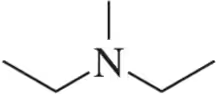
How many unique ¹H NMR signals would you expect in an NMR spectrum for the following molecules?
(b) Chemical structure of triethylamine, showing a nitrogen atom bonded to three ethyl groups.

Verified step by step guidance
1
Identify the molecule in question. Understanding the structure is crucial for predicting the number of unique ¹H NMR signals.
Examine the symmetry of the molecule. Symmetrical molecules often have fewer unique signals because equivalent hydrogens produce the same signal.
Determine the number of chemically distinct hydrogen environments. Hydrogens in different environments will produce different signals.
Consider the presence of chiral centers or stereochemistry, as these can affect the equivalence of hydrogen atoms.
Count the number of unique hydrogen environments to predict the number of unique ¹H NMR signals. Each distinct environment corresponds to a separate signal in the NMR spectrum.

Verified video answer for a similar problem:

This video solution was recommended by our tutors as helpful for the problem above.
Was this helpful?

Key Concepts

Here are the essential concepts you must grasp in order to answer the question correctly.

¹H NMR Spectroscopy

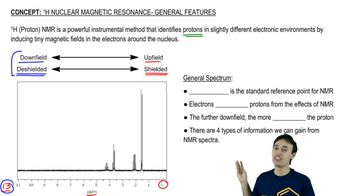
¹H NMR (Proton Nuclear Magnetic Resonance) spectroscopy is a technique used to determine the structure of organic compounds by analyzing the magnetic environment of hydrogen atoms. Each unique hydrogen environment in a molecule produces a distinct signal in the NMR spectrum, allowing chemists to deduce the number and type of hydrogen atoms present.
Recommended video:
Guided course
10:06
General NMR Features

Chemical Equivalence

Chemical equivalence in NMR refers to hydrogen atoms that are in identical environments within a molecule, resulting in them producing the same NMR signal. Identifying chemically equivalent protons is crucial for predicting the number of unique signals in an NMR spectrum, as equivalent protons do not contribute additional signals.
Recommended video:
3:11
Chemical Reactions of Phosphate Anhydrides Concept 1

Symmetry in Molecules

Symmetry in molecules can significantly affect the number of unique ¹H NMR signals. Symmetrical molecules often have fewer unique signals because symmetry can make different hydrogen atoms chemically equivalent. Recognizing symmetry elements, such as planes or axes, helps in determining which protons are equivalent and thus how many distinct signals will appear in the NMR spectrum.
Recommended video:
Guided course
00:25
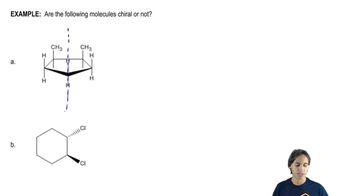
Determining Chirality with Plane of Symmetry