Textbook Question
For the following molecules, give the integration you would expect for the signal associated with the hydrogens at the labeled carbons. [Pay attention to the symmetry, or lack of symmetry, in the molecules.]
(c)
2
views

 Mullins 1st EditionCh. 15 - Structural Identification II: Nuclear Magnetic Resonance SpectroscopyProblem 57b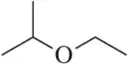
 Verified step by step guidance
 10:06
10:06
 3:11
3:11 00:25
00:25For the following molecules, give the integration you would expect for the signal associated with the hydrogens at the labeled carbons. [Pay attention to the symmetry, or lack of symmetry, in the molecules.]
(c)
How many distinct signals would you expect to see in the ¹H NMR spectrum of the following molecules? [Ignore diastereotopic hydrogens for the sake of this assessment.]
(c)
How many distinct signals would you expect to see in the ¹H NMR spectrum of the following molecules? [Ignore diastereotopic hydrogens for the sake of this assessment.]
(f)
Draw the expected results of a DEPT sequence for the molecules shown.
(b)
How many distinct signals would you expect to see in the ¹H NMR spectrum of the following molecules? [Ignore diastereotopic hydrogens for the sake of this assessment.]
(a)
With information from the ¹H NMR and the ¹³C DEPT spectra, structure elucidation becomes even easier. Provide the structure that corresponds to the following data. [The identity of the carbons comes from the DEPT experiment.]
C₆H₁₁BrO₂
IR: 1745 cm ⁻¹
¹H NMR: δ 1.25 (t, 3H), 2.18 (quint, 2H), 2.58 (t, 2H), 3.46 (t, 2H), 4.15 (q, 2H)
¹³C NMR: δ 14.2 (CH₃) , 27.8 (CH₂) , 32.5 (CH₂) , 32.6 (CH₂) , 60.5 (CH₂) , 172.4 (C)