Ch. 15 - Structural Identification II: Nuclear Magnetic Resonance Spectroscopy
Mullins - Organic Chemistry: A Learner Centered Approach 1st Edition
Mullins1st EditionOrganic Chemistry: A Learner Centered ApproachISBN: 9780137566471Not the one you use?Change textbook
Chapter 14, Problem 62e

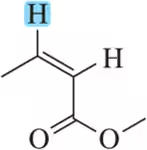
For the hydrogen(s) screened in blue, draw the signal you would expect to see in a ¹H NMR spectrum. At which chemical shift would the signal appear?
(e) Chemical structure with a blue-highlighted hydrogen on a methyl group adjacent to a carbonyl group.

Verified step by step guidance
1
Identify the hydrogen atoms screened in blue in the given molecular structure. These are the hydrogen atoms for which you need to predict the NMR signal.
Consider the electronic environment surrounding these hydrogen atoms. Factors such as electronegativity of nearby atoms, hybridization, and resonance effects can influence the chemical shift.
Determine the chemical shift range for the hydrogen atoms based on their environment. Use typical chemical shift values for different types of hydrogen environments, such as alkyl, alkenyl, aromatic, or aldehyde hydrogens.
Predict the multiplicity of the NMR signal. Consider the number of neighboring hydrogen atoms (n) that can cause splitting, using the n+1 rule to determine the number of peaks in the signal.
Sketch the expected NMR signal, indicating the chemical shift range and the multiplicity. Ensure the signal reflects the predicted chemical shift and splitting pattern based on the molecular structure.

Verified video answer for a similar problem:

This video solution was recommended by our tutors as helpful for the problem above.
Was this helpful?

Key Concepts

Here are the essential concepts you must grasp in order to answer the question correctly.

¹H NMR Spectroscopy

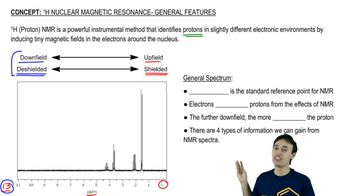
¹H NMR spectroscopy is a technique used to determine the structure of organic compounds by analyzing the magnetic environment of hydrogen atoms. It provides information about the number of hydrogen atoms, their chemical environment, and connectivity within a molecule, which is crucial for identifying functional groups and molecular structure.
Recommended video:
Guided course
10:06
General NMR Features

Chemical Shift

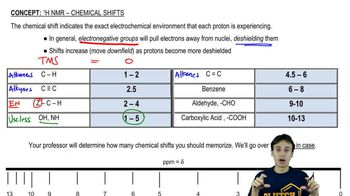
Chemical shift in NMR spectroscopy refers to the position of an NMR signal relative to a standard reference, typically tetramethylsilane (TMS). It is measured in parts per million (ppm) and indicates the electronic environment surrounding a nucleus. Factors such as electronegativity, hybridization, and nearby functional groups influence the chemical shift, helping to deduce structural information.
Recommended video:
Guided course
11:44
1H NMR Chemical Shifts

Signal Splitting

Signal splitting in NMR, also known as spin-spin coupling, occurs when hydrogen atoms are influenced by neighboring non-equivalent hydrogens, causing the NMR signal to split into multiple peaks. The number of peaks follows the n+1 rule, where n is the number of adjacent hydrogens, providing insights into the connectivity and proximity of atoms within a molecule.
Recommended video:
Guided course
02:02
Identifying Proton Signals