Ch. 15 - Structural Identification II: Nuclear Magnetic Resonance Spectroscopy
Mullins - Organic Chemistry: A Learner Centered Approach 1st Edition
Mullins1st EditionOrganic Chemistry: A Learner Centered ApproachISBN: 9780137566471Not the one you use?Change textbook
Chapter 14, Problem 64b

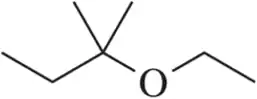
Draw the ¹H NMR spectrum you would expect to see for each of the molecules in Assessment 15.63.
(b) Chemical structure of ethyl isopropyl ether, showing an oxygen atom bonded to an ethyl and isopropyl group.

Verified step by step guidance
1
Identify the molecular structure of the compound in Assessment 15.63 part b. Understanding the structure is crucial for predicting the ¹H NMR spectrum.
Determine the number of unique hydrogen environments in the molecule. Each unique environment corresponds to a different signal in the ¹H NMR spectrum.
Consider the chemical shift for each type of hydrogen. Chemical shifts are influenced by the electronic environment surrounding the hydrogen atoms, such as electronegative atoms or π-bonds nearby.
Evaluate the splitting pattern for each signal. The splitting pattern is determined by the number of neighboring hydrogens (n+1 rule), where n is the number of adjacent hydrogens.
Estimate the integration of each signal. The integration corresponds to the number of hydrogens contributing to each signal, providing information about the relative number of hydrogens in each environment.

Verified video answer for a similar problem:

This video solution was recommended by our tutors as helpful for the problem above.
Was this helpful?

Key Concepts

Here are the essential concepts you must grasp in order to answer the question correctly.

¹H NMR Spectroscopy

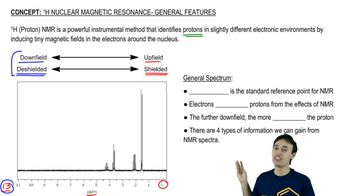
¹H NMR (Proton Nuclear Magnetic Resonance) spectroscopy is a technique used to determine the structure of organic compounds by analyzing the magnetic environment of hydrogen atoms. It provides information about the number of hydrogen environments, their chemical shifts, and the splitting patterns due to neighboring hydrogens, which helps in deducing the molecular structure.
Recommended video:
Guided course
10:06
General NMR Features

Chemical Shift

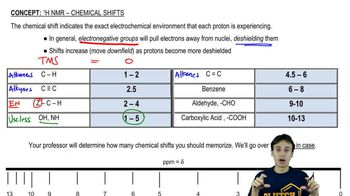
Chemical shift in ¹H NMR refers to the resonant frequency of a hydrogen nucleus relative to a standard reference, typically tetramethylsilane (TMS). It is influenced by the electronic environment surrounding the hydrogen atom, with shifts indicating different types of chemical environments, such as aliphatic, aromatic, or adjacent to electronegative atoms.
Recommended video:
Guided course
11:44
1H NMR Chemical Shifts

Spin-Spin Coupling

Spin-spin coupling in ¹H NMR results in the splitting of NMR signals into multiplets, providing information about the number of neighboring hydrogen atoms. The pattern and number of peaks in a multiplet follow the n+1 rule, where n is the number of adjacent hydrogens, helping to elucidate the connectivity and structure of the molecule.
Recommended video:
Guided course
02:54
Sonogashira Coupling Reaction