Ch. 15 - Structural Identification II: Nuclear Magnetic Resonance Spectroscopy
Mullins - Organic Chemistry: A Learner Centered Approach 1st Edition
Mullins1st EditionOrganic Chemistry: A Learner Centered ApproachISBN: 9780137566471Not the one you use?Change textbook
Chapter 14, Problem 67a

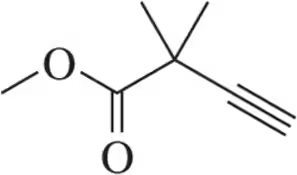
Draw the ¹³C NMR spectrum you would expect to see for each of the molecules shown.
(a) Chemical structure of methyl propanoate with a terminal alkyne group, showing bonds and functional groups.

Verified step by step guidance
1
Identify the unique carbon environments in the molecule. Each unique carbon environment will correspond to a distinct signal in the ¹³C NMR spectrum.
Consider the symmetry of the molecule. Symmetrical molecules may have fewer unique carbon environments due to equivalent positions.
Determine the chemical shift range for each type of carbon. For example, sp³ hybridized carbons typically appear between 0-50 ppm, sp² hybridized carbons between 100-150 ppm, and carbonyl carbons around 160-220 ppm.
Consider the effects of electronegative atoms or groups attached to the carbons. Electronegative atoms can deshield the carbon, causing a downfield shift (higher ppm value).
Sketch the ¹³C NMR spectrum, placing each signal at the appropriate chemical shift based on the analysis of the carbon environments and their electronic surroundings.

Verified video answer for a similar problem:

This video solution was recommended by our tutors as helpful for the problem above.
Video duration:
9m
Was this helpful?

Key Concepts

Here are the essential concepts you must grasp in order to answer the question correctly.

¹³C NMR Spectroscopy

¹³C NMR spectroscopy is a technique used to study the carbon atoms in organic molecules. It provides information about the number of unique carbon environments in a molecule by detecting the magnetic environment of carbon-13 isotopes. Each distinct carbon environment appears as a separate signal in the spectrum, allowing chemists to deduce structural information about the molecule.
Recommended video:
Guided course
10:06
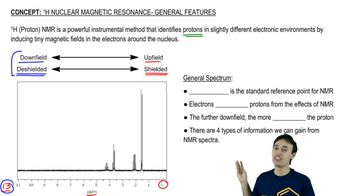
General NMR Features

Chemical Shift

Chemical shift in NMR spectroscopy refers to the position of an NMR signal relative to a standard reference point, typically measured in parts per million (ppm). It provides insight into the electronic environment surrounding a nucleus, with shifts influenced by factors such as electronegativity, hybridization, and nearby functional groups. Understanding chemical shifts helps in identifying the types of carbon atoms present in a molecule.
Recommended video:
Guided course
11:44
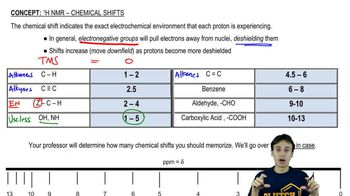
1H NMR Chemical Shifts

Symmetry and Equivalent Carbons

In ¹³C NMR, symmetry in a molecule can lead to equivalent carbon atoms, which produce identical signals. Identifying symmetry elements, such as planes or axes, helps determine the number of unique carbon signals expected in the spectrum. Recognizing equivalent carbons is crucial for predicting the correct number of peaks and understanding the molecular structure.
Recommended video:
Guided course
01:10
Determining Chirality with Plane of Symmetry