Ch. 15 - Structural Identification II: Nuclear Magnetic Resonance Spectroscopy
Mullins - Organic Chemistry: A Learner Centered Approach 1st Edition
Mullins1st EditionOrganic Chemistry: A Learner Centered ApproachISBN: 9780137566471Not the one you use?Change textbook
Chapter 14, Problem 81a

(a) Using the ¹H NMR spectra, identify the reactants and product for this reaction.
<IMAGE>

Verified step by step guidance
1
Begin by examining the ¹H NMR spectra provided. Identify the number of signals present in each spectrum, as this indicates the number of different types of hydrogen environments in the molecule.
Analyze the chemical shift of each signal. Chemical shifts can provide information about the electronic environment of the hydrogens, helping to identify functional groups or structural features.
Look at the integration of each signal, which indicates the relative number of hydrogens contributing to that signal. This can help determine the ratio of different types of hydrogens in the molecule.
Examine the splitting patterns of the signals (singlet, doublet, triplet, etc.). The splitting pattern can provide information about the number of neighboring hydrogens, which helps in deducing the connectivity of the atoms.
Compare the spectra of the reactants and the product. Identify changes in the number of signals, chemical shifts, integration, and splitting patterns to deduce the structural changes that occurred during the reaction, thus identifying the reactants and the product.

Key Concepts

Here are the essential concepts you must grasp in order to answer the question correctly.

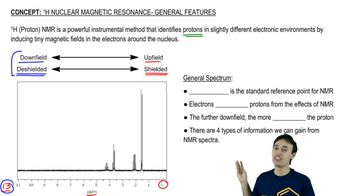
¹H NMR Spectroscopy

¹H NMR (Proton Nuclear Magnetic Resonance) spectroscopy is a technique used to determine the structure of organic compounds by analyzing the magnetic environment of hydrogen atoms. It provides information about the number of hydrogen environments, their chemical shifts, and the splitting patterns, which help in identifying functional groups and connectivity in molecules.
Recommended video:
Guided course
10:06
General NMR Features

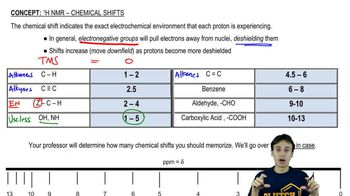
Chemical Shift

Chemical shift in ¹H NMR refers to the resonant frequency of a nucleus relative to a standard in a magnetic field. It is measured in parts per million (ppm) and provides insights into the electronic environment surrounding the hydrogen atoms. Different functional groups cause characteristic shifts, aiding in the identification of molecular structures.
Recommended video:
Guided course
11:44
1H NMR Chemical Shifts

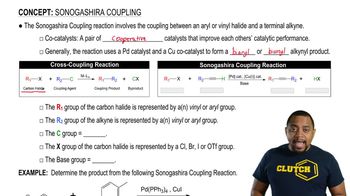
Spin-Spin Coupling

Spin-spin coupling in ¹H NMR results in the splitting of NMR signals into multiplets, providing information about the number of neighboring hydrogen atoms. This phenomenon occurs due to the interaction between magnetic fields of adjacent nuclei, and the pattern of splitting (doublet, triplet, etc.) helps deduce the connectivity and arrangement of atoms in a molecule.
Recommended video:
Guided course
02:54
Sonogashira Coupling Reaction