
Ch. 15 - Structural Identification II: Nuclear Magnetic Resonance Spectroscopy
Mullins - Organic Chemistry: A Learner Centered Approach 1st Edition
Mullins1st EditionOrganic Chemistry: A Learner Centered ApproachISBN: 9780137566471Not the one you use?Change textbook
Chapter 14, Problem 3

(a) Rank the following bonds in terms of the strength of their bond dipole (1 = weakest, 6 = strongest).
(b) Which carbon has the largest δ⁺ ?
C―F, C―Br, C―I, C―H, C―C, C―Cl

Verified step by step guidance
1
Step 1: Understand the concept of bond dipole strength. Bond dipole strength is determined by the difference in electronegativity between the two atoms forming the bond. The greater the electronegativity difference, the stronger the bond dipole.
Step 2: Compare the electronegativity values of the atoms involved in each bond. Fluorine (F) has the highest electronegativity, followed by chlorine (Cl), bromine (Br), iodine (I), hydrogen (H), and carbon (C). Use the periodic table to confirm these values.
Step 3: Rank the bonds based on the electronegativity difference between carbon and the other atom in the bond. For example, the C―F bond will have the strongest dipole because fluorine has the highest electronegativity difference with carbon, while the C―C bond will have the weakest dipole because both atoms are the same and have no electronegativity difference.
Step 4: To determine which carbon has the largest δ⁺ (partial positive charge), focus on the bond where carbon is bonded to the atom with the highest electronegativity. The larger the electronegativity difference, the more δ⁺ charge is induced on the carbon atom.
Step 5: Summarize the ranking of bond dipole strengths and identify the carbon with the largest δ⁺ based on the electronegativity differences calculated in the previous steps.

Verified video answer for a similar problem:

This video solution was recommended by our tutors as helpful for the problem above.
Video duration:
7m
Was this helpful?

Key Concepts

Here are the essential concepts you must grasp in order to answer the question correctly.

Electronegativity

Electronegativity is a measure of an atom's ability to attract and hold onto electrons in a chemical bond. In the context of the given bonds, the differences in electronegativity between carbon and the halogens (F, Br, Cl, I) determine the bond dipole strength. The greater the electronegativity difference, the stronger the bond dipole, leading to a more polarized bond.
Recommended video:
Guided course
1:47
Electronegativity

Bond Dipole Moment

The bond dipole moment is a vector quantity that represents the polarity of a bond. It is calculated as the product of the charge difference between the two atoms and the distance between them. In this question, the bond dipole strength is influenced by both the electronegativity of the atoms involved and the bond length, with stronger dipoles indicating a greater separation of charge.
Recommended video:
Guided course
01:46
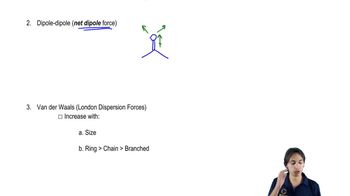
How dipole-dipole forces work.

Partial Charges (δ⁺ and δ⁻)

Partial charges (δ⁺ and δ⁻) arise in polar covalent bonds due to the unequal sharing of electrons. The atom with higher electronegativity acquires a partial negative charge (δ⁻), while the less electronegative atom acquires a partial positive charge (δ⁺). In this question, identifying which carbon has the largest δ⁺ involves analyzing the bonds it forms with halogens, particularly focusing on the bond dipole strengths.
Recommended video:
Guided course
01:34
Calculating formal and net charge.