Textbook Question
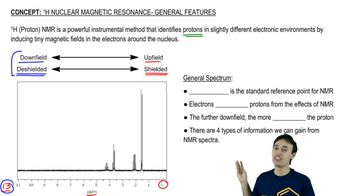
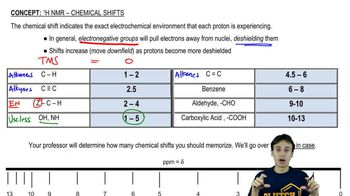
The methyl hydrogens in propane appear at a chemical shift of 0.9 ppm, whereas the methyl hydrogens of propene appear around 2.5 ppm. Explain.
1
views

 Mullins 1st EditionCh. 15 - Structural Identification II: Nuclear Magnetic Resonance SpectroscopyProblem 21
 Verified step by step guidance
 10:06
10:06
 11:44
11:44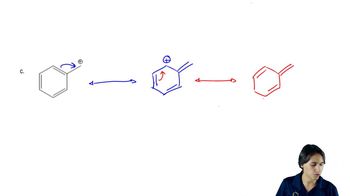 03:04
03:04The methyl hydrogens in propane appear at a chemical shift of 0.9 ppm, whereas the methyl hydrogens of propene appear around 2.5 ppm. Explain.
For the molecules shown, give the number of signals expected and the relative ratio of the signal integrations.
(b)
An unknown compound (C₇H₆O) gives the IR spectrum shown here. At what chemical shifts would you expect to see signals in the ¹H NMR spectrum?
<IMAGE>
In Figure 15.34, Ha was assumed to be 'up.' How does the analysis change if we assume instead that Ha is down?
Without worrying about the relative location of the signals (i.e., the chemical shift) or the splitting patterns, draw a spectrum of the following molecule, being sure to indicate the integration of each peak. Label each signal based on the set of equivalent hydrogens to which it corresponds. [We expand on this question in future assessments.]
Without worrying about the relative location of the signals (i.e., the chemical shift) or the splitting patterns, draw a spectrum of the following molecule. Be sure to label each signal based on the set of equivalent hydrogens to which it corresponds.