Ch. 14 - Structural Identification I: Infrared Spectroscopy and Mass Spectrometry
Mullins - Organic Chemistry: A Learner Centered Approach 1st Edition
Mullins1st EditionOrganic Chemistry: A Learner Centered ApproachISBN: 9780137566471Not the one you use?Change textbook
Chapter 13, Problem 18a

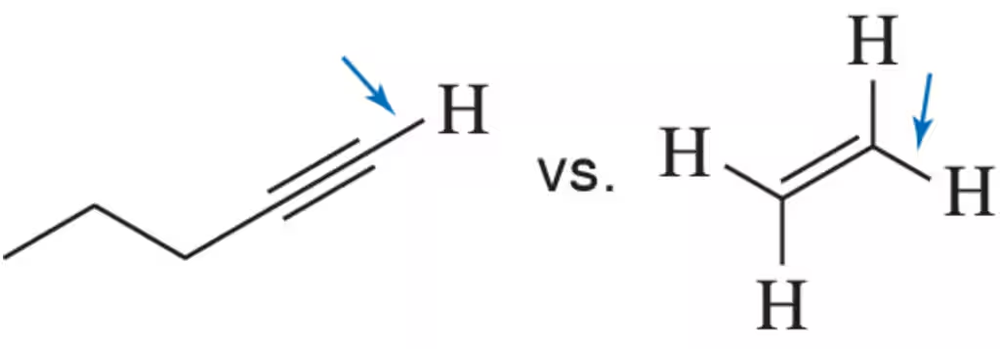
Would you expect an acetylenic C―H to absorb at a higher or lower wavenumber than the C―H in ethene?
Comparison of acetylenic C―H and ethene C―H bonds with arrows indicating hydrogen positions.

Verified step by step guidance
1
Understand the concept of wavenumber in IR spectroscopy: Wavenumber is inversely proportional to wavelength and is directly related to the energy of the bond vibration. Higher wavenumbers correspond to higher energy vibrations.
Identify the types of C―H bonds in question: An acetylenic C―H bond is found in alkynes, where the carbon is sp-hybridized. In ethene, the C―H bond is found in alkenes, where the carbon is sp2-hybridized.
Consider the hybridization of the carbon atoms: sp-hybridized carbons (as in alkynes) have more s-character (50%) compared to sp2-hybridized carbons (33% s-character) in alkenes. More s-character results in a stronger, shorter bond.
Relate bond strength to wavenumber: Stronger bonds typically absorb at higher wavenumbers because they require more energy to vibrate.
Conclude based on bond strength and hybridization: Since the acetylenic C―H bond is stronger due to higher s-character, it will absorb at a higher wavenumber compared to the C―H bond in ethene.

Verified video answer for a similar problem:

This video solution was recommended by our tutors as helpful for the problem above.
Was this helpful?

Key Concepts

Here are the essential concepts you must grasp in order to answer the question correctly.

Infrared Spectroscopy

Infrared spectroscopy is a technique used to identify functional groups in organic molecules by measuring the absorption of infrared light, which causes molecular vibrations. Different bonds absorb at characteristic wavenumbers, allowing for the identification of specific types of bonds, such as C―H, C=C, and C≡C, based on their unique vibrational frequencies.
Recommended video:
2:56
The UV-Vis Spectroscopy Concept 1

Bond Strength and Wavenumber

The wavenumber at which a bond absorbs infrared light is related to the bond strength and the masses of the atoms involved. Stronger bonds, such as triple bonds, typically absorb at higher wavenumbers compared to double or single bonds. This is because stronger bonds require more energy to vibrate, resulting in higher frequency and wavenumber absorption.
Recommended video:
Guided course
06:00
Single bonds, double bonds, and triple bonds.

Acetylenic vs. Ethylenic C―H Bonds

Acetylenic C―H bonds, found in alkynes, are associated with sp-hybridized carbon atoms, while ethylenic C―H bonds, found in alkenes, involve sp2-hybridized carbons. The sp-hybridized C―H bond is stronger and shorter than the sp2-hybridized C―H bond, leading to a higher wavenumber absorption for acetylenic C―H in infrared spectroscopy compared to ethylenic C―H.
Recommended video:
Guided course
04:39
Heterolytic vs. Homolytic Bond Cleavage .