Ch. 14 - Structural Identification I: Infrared Spectroscopy and Mass Spectrometry
Mullins - Organic Chemistry: A Learner Centered Approach 1st Edition
Mullins1st EditionOrganic Chemistry: A Learner Centered ApproachISBN: 9780137566471Not the one you use?Change textbook
Chapter 13, Problem 43b

Identify the peaks in the mass spectrum of octan-4-one that correspond to (b) the McLafferty rearrangement.
<IMAGE>

Verified step by step guidance
1
Understand the McLafferty rearrangement: This is a reaction in mass spectrometry where a molecule undergoes a rearrangement involving the transfer of a hydrogen atom and the cleavage of a bond, typically resulting in a neutral molecule and a radical cation.
Identify the structure of octan-4-one: Octan-4-one is a ketone with the formula C8H16O. The carbonyl group is located at the fourth carbon in the chain.
Locate the gamma hydrogen: In the McLafferty rearrangement, a hydrogen atom three carbons away from the carbonyl group (gamma position) is involved. For octan-4-one, identify the gamma hydrogen relative to the carbonyl group.
Illustrate the rearrangement: Draw the mechanism showing the transfer of the gamma hydrogen to the carbonyl oxygen, resulting in the cleavage of the bond between the alpha and beta carbons, forming a double bond and a neutral alkene molecule.
Determine the mass of the resulting fragments: Calculate the mass of the radical cation and the neutral alkene formed from the McLafferty rearrangement. These masses correspond to the peaks you would observe in the mass spectrum.

Verified video answer for a similar problem:

This video solution was recommended by our tutors as helpful for the problem above.
Was this helpful?

Key Concepts

Here are the essential concepts you must grasp in order to answer the question correctly.

Mass Spectrometry

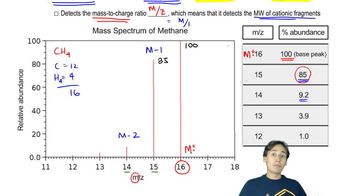
Mass spectrometry is an analytical technique used to measure the mass-to-charge ratio of ions. It helps identify the composition of a sample by generating a mass spectrum, which displays the masses of fragments. Understanding how molecules break apart and form ions is crucial for interpreting these spectra.
Recommended video:
Guided course
01:25
How to Read a Mass Spectrum

McLafferty Rearrangement

The McLafferty rearrangement is a specific fragmentation pattern observed in mass spectrometry, particularly in carbonyl compounds. It involves a hydrogen atom transfer from a gamma-carbon (three carbons away from the carbonyl group) to the carbonyl oxygen, followed by cleavage of the bond between the alpha and beta carbons, resulting in a stable enol and a neutral alkene.
Recommended video:
Guided course
06:08
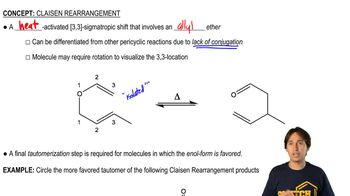
Definition of Claisen Rearrangement

Fragmentation Patterns

Fragmentation patterns in mass spectrometry refer to the specific ways in which a molecule breaks apart into smaller ions. These patterns are influenced by the structure of the molecule and the stability of the resulting fragments. Recognizing these patterns, such as the McLafferty rearrangement, is essential for deducing the structure of the original compound from its mass spectrum.
Recommended video:
Guided course
08:06
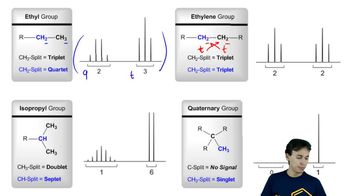
Common Splitting Patterns