Ch. 13 - Alcohols, Ethers and Related Compounds: Substitution and Elimination
Mullins - Organic Chemistry: A Learner Centered Approach 1st Edition
Mullins1st EditionOrganic Chemistry: A Learner Centered ApproachISBN: 9780137566471Not the one you use?Change textbook
Chapter 12, Problem 21b

Which of the following bases would favorably deprotonate a hydroxyl group?
(b) NaOH

Verified step by step guidance
1
Understand the concept of deprotonation: Deprotonation is the removal of a proton (H⁺) from a molecule, which in this case is a hydroxyl group (OH). The ability of a base to deprotonate a hydroxyl group depends on its strength.
Identify the hydroxyl group: The hydroxyl group is represented as OH. It is a common functional group in organic chemistry, consisting of an oxygen atom bonded to a hydrogen atom.
Consider the strength of the base: Sodium hydroxide (NaOH) is a strong base. Strong bases are more likely to deprotonate weak acids, such as alcohols, which contain hydroxyl groups.
Evaluate the acidity of the hydroxyl group: Hydroxyl groups in alcohols are weakly acidic. The pKa of a typical alcohol is around 16-18, indicating that it can be deprotonated by a strong base.
Conclude the likelihood of deprotonation: Given that NaOH is a strong base, it can favorably deprotonate a hydroxyl group by removing the hydrogen ion (H⁺), forming water (H₂O) and the corresponding alkoxide ion.

Verified video answer for a similar problem:

This video solution was recommended by our tutors as helpful for the problem above.
Video duration:
3m
Was this helpful?

Key Concepts

Here are the essential concepts you must grasp in order to answer the question correctly.

Acid-Base Chemistry

Acid-base chemistry involves the transfer of protons between molecules. A base is a substance that can accept protons, while an acid can donate them. Understanding the strength of acids and bases is crucial for predicting reactions, such as deprotonation, where a base removes a proton from an acid.
Recommended video:
Guided course
02:49
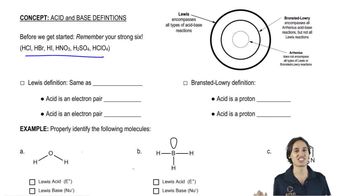
The Lewis definition of acids and bases.

pKa and Basicity

The pKa value of a compound indicates its acidity; lower pKa values mean stronger acids. A base can deprotonate an acid if the base's conjugate acid has a higher pKa than the acid being deprotonated. NaOH is a strong base, capable of deprotonating hydroxyl groups due to its high basicity.
Recommended video:
Guided course
07:45
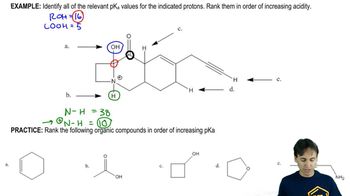
Identifying pKa values

Hydroxyl Group

A hydroxyl group consists of an oxygen atom bonded to a hydrogen atom (-OH). It is a common functional group in organic chemistry, found in alcohols. The ability of a base to deprotonate a hydroxyl group depends on the base's strength and the acidity of the hydroxyl group.
Recommended video:
Guided course
04:42
Sequence Groups