Ch. 13 - Alcohols, Ethers and Related Compounds: Substitution and Elimination
Mullins - Organic Chemistry: A Learner Centered Approach 1st Edition
Mullins1st EditionOrganic Chemistry: A Learner Centered ApproachISBN: 9780137566471Not the one you use?Change textbook
Chapter 12, Problem 15c

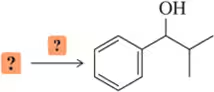
Suggest a reagent and a reactant that could be combined to make each of the following alcohols.
(c) Chemical reaction diagram with benzyl alcohol product; reactant and reagent are unspecified.

Verified step by step guidance
1
Identify the functional groups in the starting material and the product. The starting material has a chlorine atom attached to a carbon chain, indicating it is an alkyl halide. The product has an alcohol group (-OH) in place of the chlorine.
Recognize that the transformation involves replacing the chlorine atom with a hydroxyl group. This suggests a nucleophilic substitution reaction, where the chlorine is replaced by a hydroxide ion.
Consider the type of nucleophilic substitution reaction. Since the starting material is a primary alkyl halide, an SN2 reaction is likely, where a strong nucleophile attacks the carbon attached to the chlorine.
Select a suitable reagent for the nucleophilic substitution. A common choice is sodium hydroxide (NaOH) or potassium hydroxide (KOH), which provides the hydroxide ion (OH⁻) needed for the substitution.
Propose the reaction: Treat the alkyl halide with NaOH or KOH in a suitable solvent, such as water or an alcohol, to facilitate the SN2 reaction and form the desired alcohol product.

Verified video answer for a similar problem:

This video solution was recommended by our tutors as helpful for the problem above.
Was this helpful?

Key Concepts

Here are the essential concepts you must grasp in order to answer the question correctly.

Alcohol Functional Group

Alcohols are organic compounds characterized by the presence of one or more hydroxyl (-OH) groups attached to a carbon atom. Understanding the structure and properties of alcohols is essential for identifying suitable reagents and reactants for their synthesis. The position of the hydroxyl group can significantly influence the reactivity and properties of the alcohol.
Recommended video:
Guided course
02:36
Identifying Functional Groups

Reagents in Organic Synthesis

Reagents are substances that are added to a reaction to cause a chemical change. In the context of synthesizing alcohols, common reagents include reducing agents like lithium aluminum hydride (LiAlH4) or borane (BH3), which can convert carbonyl compounds (like aldehydes or ketones) into alcohols. Knowing the appropriate reagents is crucial for successful alcohol synthesis.
Recommended video:
1:16
Synthesis of Amino Acids: Strecker Synthesis Example 1

Reaction Mechanisms

Understanding reaction mechanisms is vital for predicting the products of chemical reactions. For alcohol synthesis, mechanisms such as nucleophilic addition or reduction pathways are often involved. Familiarity with these mechanisms helps in selecting the correct reactants and reagents to achieve the desired alcohol structure.
Recommended video:
Guided course
02:16
Heck Reaction Mechanism