Ch. 13 - Alcohols, Ethers and Related Compounds: Substitution and Elimination
Mullins - Organic Chemistry: A Learner Centered Approach 1st Edition
Mullins1st EditionOrganic Chemistry: A Learner Centered ApproachISBN: 9780137566471Not the one you use?Change textbook
Chapter 12, Problem 6f

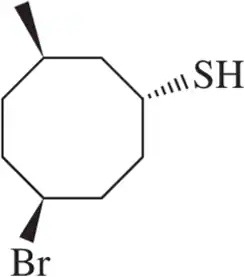
Provide the IUPAC name for the following molecules.
(f) Cyclooctane ring with bromine and thiol groups attached, showing stereochemistry with wedge and dash bonds.

Verified step by step guidance
1
Identify the longest continuous carbon chain in the molecule. This chain will determine the base name of the compound according to the number of carbon atoms it contains.
Number the carbon atoms in the longest chain starting from the end nearest to the first point of branching or the highest priority functional group.
Identify and name any substituents (alkyl groups, halogens, etc.) attached to the main chain. Use prefixes like 'methyl-', 'ethyl-', 'chloro-', etc., based on the type of substituent.
Assign a locant (position number) to each substituent based on its position on the main chain. Ensure that the numbers are as low as possible.
Combine the names of the substituents with the base name of the compound, arranging substituents alphabetically and using hyphens to separate numbers from names. Use commas to separate multiple locants for identical substituents.

Verified video answer for a similar problem:

This video solution was recommended by our tutors as helpful for the problem above.
Was this helpful?

Key Concepts

Here are the essential concepts you must grasp in order to answer the question correctly.

IUPAC Nomenclature

IUPAC nomenclature is a standardized system for naming chemical compounds. It ensures that each compound has a unique name that describes its structure. The system uses specific rules to identify the longest carbon chain, functional groups, and substituents, assigning prefixes, infixes, and suffixes accordingly.
Recommended video:
Guided course
03:43
The different parts of an IUPAC name

Functional Groups

Functional groups are specific groups of atoms within molecules that are responsible for the characteristic chemical reactions of those molecules. Identifying functional groups such as alcohols, ketones, or carboxylic acids is crucial in determining the IUPAC name, as they influence the suffix and priority in naming.
Recommended video:
Guided course
02:36
Identifying Functional Groups

Carbon Chain Identification

Identifying the longest continuous carbon chain in a molecule is a fundamental step in IUPAC nomenclature. This chain serves as the base name of the compound, and its length determines the root name (e.g., methane, ethane, propane). Substituents and functional groups are then named and numbered based on their position relative to this main chain.
Recommended video:
Guided course
04:25
Name the longest carbon chain