Ch. 13 - Alcohols, Ethers and Related Compounds: Substitution and Elimination
Mullins - Organic Chemistry: A Learner Centered Approach 1st Edition
Mullins1st EditionOrganic Chemistry: A Learner Centered ApproachISBN: 9780137566471Not the one you use?Change textbook
Chapter 12, Problem 2

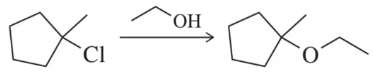
Provide a mechanism for the following SN1 reaction. What roles (acid/base/nucleophile/electrophile) does ethanol play in the reaction? What functional group is made in this reaction?

Verified step by step guidance
1
Step 1: Identify the reaction type. This is an SN1 reaction, which proceeds via a two-step mechanism involving the formation of a carbocation intermediate. The substrate is a tertiary alkyl chloride, which is favorable for SN1 due to the stability of the tertiary carbocation.
Step 2: The first step of the mechanism involves the departure of the chloride ion (Cl⁻), which acts as the leaving group. This generates a tertiary carbocation intermediate. The bond between the carbon and chlorine breaks heterolytically, leaving the carbon atom with a positive charge.
Step 3: Ethanol (CH₃CH₂OH) acts as the nucleophile in this reaction. The oxygen atom in ethanol has lone pairs of electrons, which it uses to attack the positively charged carbocation. This forms a new bond between the oxygen atom of ethanol and the carbon atom of the carbocation.
Step 4: After the nucleophilic attack, a proton (H⁺) is removed from the ethanol group by another ethanol molecule or a base present in the solution. This deprotonation step leads to the formation of the final product, where the oxygen atom is bonded to the carbon atom, creating an ether functional group.
Step 5: The functional group formed in this reaction is an ether (R-O-R'). Ethanol plays the role of both the nucleophile (attacking the carbocation) and the base (removing the proton in the final step).

Verified video answer for a similar problem:

This video solution was recommended by our tutors as helpful for the problem above.
Video duration:
2m
Was this helpful?

Key Concepts

Here are the essential concepts you must grasp in order to answer the question correctly.

S_N1 Reaction Mechanism

The S_N1 reaction mechanism involves a two-step process where the leaving group departs first, forming a carbocation intermediate, followed by the nucleophile attacking the carbocation. This mechanism is characteristic of tertiary substrates due to their stability in forming carbocations. Understanding this process is crucial for predicting the outcome of the reaction and the role of various reactants.
Recommended video:
Guided course
02:16
Heck Reaction Mechanism

Roles of Ethanol

In the context of an S_N1 reaction, ethanol acts primarily as a nucleophile, attacking the carbocation formed after the leaving group departs. Additionally, ethanol can also function as a solvent, stabilizing the carbocation and facilitating the reaction. Its role as a nucleophile is significant in determining the product formed in the reaction.
Recommended video:
Guided course
01:50
Conversion of ethanol from electron dot to bondline

Functional Group Formation

The functional group formed in an S_N1 reaction typically depends on the substrate and the nucleophile involved. In this case, if ethanol is the nucleophile, the product will likely be an ether or an alcohol, depending on the specific reaction conditions. Identifying the functional group is essential for understanding the chemical properties and reactivity of the product.
Recommended video:
Guided course
02:36
Identifying Functional Groups