Ch. 13 - Alcohols, Ethers and Related Compounds: Substitution and Elimination
Mullins - Organic Chemistry: A Learner Centered Approach 1st Edition
Mullins1st EditionOrganic Chemistry: A Learner Centered ApproachISBN: 9780137566471Not the one you use?Change textbook
Chapter 12, Problem 106f(vii,viii)

Predict the product(s) that would result when molecules (a)–(p) are allowed to react under the following conditions: (vii) HCl; (viii) HBr; If no reaction occurs, write 'no reaction.'
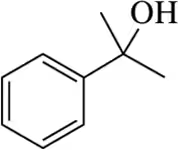
(f) Chemical structure of a phenol with a hydroxyl group (OH) attached to a benzene ring.

Verified step by step guidance
1
Identify the structure of the given molecule. The image shows a tertiary alcohol, specifically 2-phenyl-2-propanol.
Understand the reaction conditions: (vii) HCl and (viii) HBr. Both are strong acids that can protonate the hydroxyl group of the alcohol.
Consider the mechanism: The hydroxyl group will be protonated by the acid, converting it into a better leaving group (water).
Recognize that the reaction will proceed via an SN1 mechanism due to the stability of the tertiary carbocation formed after the departure of the water molecule.
Predict the product: The carbocation will be attacked by the halide ion (Cl- or Br-) to form the corresponding alkyl halide, 2-chloro-2-phenylpropane or 2-bromo-2-phenylpropane, depending on the acid used.

Verified video answer for a similar problem:

This video solution was recommended by our tutors as helpful for the problem above.
Was this helpful?

Key Concepts

Here are the essential concepts you must grasp in order to answer the question correctly.

Acid-Base Reactions

Acid-base reactions involve the transfer of protons (H+) between reactants. In organic chemistry, strong acids like HCl and HBr can protonate nucleophiles, making them more reactive. Understanding how these acids interact with different functional groups is crucial for predicting the products of the reactions.
Recommended video:
Guided course
02:49
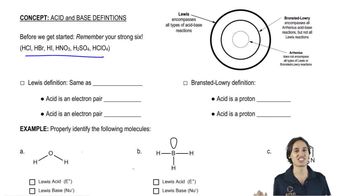
The Lewis definition of acids and bases.

Nucleophilicity and Electrophilicity

Nucleophiles are species that donate an electron pair to form a chemical bond, while electrophiles are electron-deficient species that accept electron pairs. The strength and nature of the nucleophile and electrophile involved in the reaction determine the outcome. Recognizing which molecules act as nucleophiles or electrophiles is essential for predicting reaction products.
Recommended video:
Guided course
03:
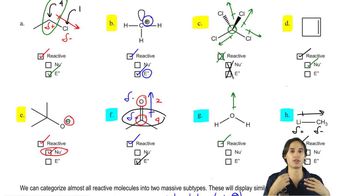
Nucleophile or Electrophile

Reaction Mechanisms

Reaction mechanisms describe the step-by-step process by which reactants transform into products. They include details about bond breaking and forming, intermediates, and transition states. Understanding the mechanism helps in predicting the products of reactions, especially when different acids are used, as they can influence the pathway taken.
Recommended video:
Guided course
02:16
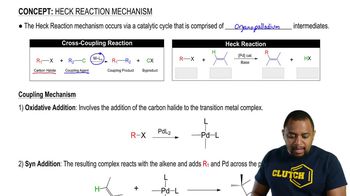
Heck Reaction Mechanism
Related Practice
Textbook Question

Predict the product(s) that would result when molecules (a)–(p) are allowed to react under the following conditions:(vii) HCl; (viii) HBr If no reaction occurs, write 'no reaction.'


(k)

2
views

Textbook Question

Predict the product(s) that would result when molecules (a)–(p) are allowed to react under the following conditions: (i) SOCl₂ ; (ii) PBr₃ ; (iii) SOCl₂ , NEt₃ (iv) 1. TsCl, Et₃N 2. NaCN; (v) 1. TsCl, Et₃N 2. NaOt-Bu (vi) H₂SO₄ (vii) HCl; (viii) HBr; (ix) PCC; (x) H₂CrO₄ , H₂O (xi) HOCl, H₂O (xii) HIO₄ If no reaction occurs, write 'no reaction.'


(f)

Textbook Question

Predict the product(s) that would result when molecules (a)–(p) are allowed to react under the following conditions: (iii) SOCl₂ , NEt₃ (iv) 1. TsCl, Et₃N 2. NaCN; If no reaction occurs, write 'no reaction.'

(f)

1
views
Textbook Question

Predict the product(s) that would result when molecules (a)–(p) are allowed to react under the following conditions: (xi) HOCl, H₂O (xii) HIO₄ If no reaction occurs, write 'no reaction.'

(f)

1
views
Textbook Question

Predict the product(s) that would result when molecules (a)–(p) are allowed to react under the following conditions: (ix) PCC; (x) H₂CrO₄ , H₂O If no reaction occurs, write 'no reaction.'

(f)

5
views
Textbook Question

Predict the product(s) that would result when molecules (a)–(p) are allowed to react under the following conditions: (v) 1. TsCl, Et₃N 2. NaOt-Bu (vi) H₂SO₄ If no reaction occurs, write 'no reaction.'

(f)

2
views