Ch. 13 - Alcohols, Ethers and Related Compounds: Substitution and Elimination
Mullins - Organic Chemistry: A Learner Centered Approach 1st Edition
Mullins1st EditionOrganic Chemistry: A Learner Centered ApproachISBN: 9780137566471Not the one you use?Change textbook
Chapter 12, Problem 100b(i)

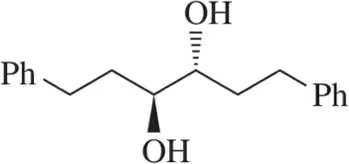
Predict the product for the acid-catalyzed pinacol rearrangement of the following diols.
(b) Chemical structure of a diol with two phenyl groups and two hydroxyl groups on adjacent carbon atoms.

Verified step by step guidance
1
Identify the structure of the diol involved in the pinacol rearrangement. Pinacol rearrangement typically involves vicinal diols, which are two hydroxyl groups on adjacent carbon atoms.
Understand the mechanism of acid-catalyzed pinacol rearrangement. The process begins with the protonation of one of the hydroxyl groups, making it a better leaving group.
Once protonated, the hydroxyl group leaves as water, forming a carbocation at the carbon where the hydroxyl group was attached. This carbocation is crucial for the rearrangement.
Consider the possibility of carbocation rearrangement. The carbocation can undergo a 1,2-shift, where an adjacent group (often a methyl or hydride) migrates to stabilize the carbocation, forming a new carbocation at the original position of the migrating group.
Finally, deprotonation occurs to form the ketone or aldehyde product. The rearrangement typically results in the conversion of the diol into a carbonyl compound, such as a ketone or aldehyde, depending on the structure of the starting diol.

Verified video answer for a similar problem:

This video solution was recommended by our tutors as helpful for the problem above.
Video duration:
5m
Was this helpful?

Key Concepts

Here are the essential concepts you must grasp in order to answer the question correctly.

Pinacol Rearrangement

Pinacol rearrangement is a chemical reaction where a 1,2-diol is converted into a carbonyl compound under acidic conditions. The reaction involves the migration of an alkyl group and the formation of a carbocation intermediate, leading to a rearranged product. Understanding the mechanism is crucial for predicting the final structure of the product.
Recommended video:
Guided course
06:08
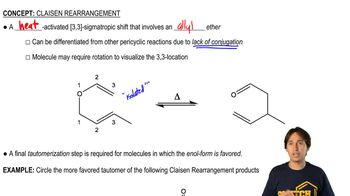
Definition of Claisen Rearrangement

Carbocation Stability

Carbocation stability is a key factor in organic reactions, influencing the direction and outcome of rearrangements. In pinacol rearrangement, the formation of a stable carbocation intermediate is essential, as it dictates the migration of groups and the final product. Factors such as hyperconjugation and resonance can stabilize carbocations, affecting the rearrangement pathway.
Recommended video:
Guided course
05:58
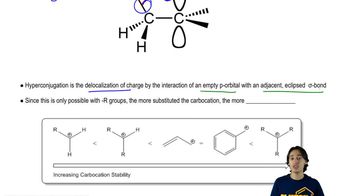
Determining Carbocation Stability

Acid Catalysis

Acid catalysis involves the use of an acid to accelerate a chemical reaction by donating protons, which can facilitate the formation of intermediates like carbocations. In pinacol rearrangement, the acid protonates the diol, leading to the loss of water and formation of a carbocation, which is a critical step in the rearrangement process.
Recommended video:
2:50
Acid-Base Catalysis Concept 3