Ch. 13 - Alcohols, Ethers and Related Compounds: Substitution and Elimination
Mullins - Organic Chemistry: A Learner Centered Approach 1st Edition
Mullins1st EditionOrganic Chemistry: A Learner Centered ApproachISBN: 9780137566471Not the one you use?Change textbook
Chapter 12, Problem 98

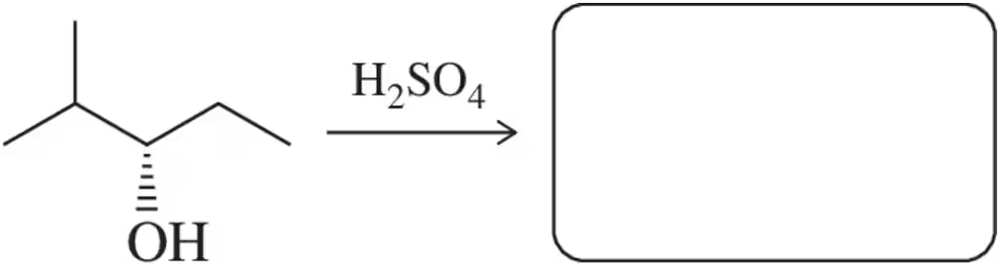
Draw a reaction coordinate diagram for the following transformation. Label all product, intermediates, and substrates.
Reaction coordinate diagram showing a substrate with an -OH group transforming under H₂SO₄, with labeled products and intermediates.

Verified step by step guidance
1
Identify the substrate, intermediates, and product for the given reaction. The substrate is the starting material, intermediates are species formed during the reaction, and the product is the final compound formed.
Determine the number of steps in the reaction mechanism. Each step corresponds to a transition state and may involve the formation of intermediates.
Sketch the reaction coordinate diagram. The x-axis represents the reaction coordinate (progress of the reaction), and the y-axis represents the potential energy of the species involved.
Plot the energy levels of the substrate, intermediates, and product. The substrate should be at a higher energy level than the product if the reaction is exergonic, and vice versa if the reaction is endergonic. Intermediates should be at energy levels between the substrate and product.
Add transition states as peaks between each intermediate and label them appropriately. Ensure that all species (substrate, intermediates, product) and transition states are clearly labeled on the diagram.

Verified video answer for a similar problem:

This video solution was recommended by our tutors as helpful for the problem above.
Video duration:
2m
Was this helpful?

Key Concepts

Here are the essential concepts you must grasp in order to answer the question correctly.

Reaction Coordinate Diagram

A reaction coordinate diagram is a graphical representation that illustrates the energy changes during a chemical reaction. The x-axis typically represents the progress of the reaction, while the y-axis shows the potential energy of the system. Key features include the reactants, products, and any intermediates, along with activation energy barriers that must be overcome for the reaction to proceed.
Recommended video:
Guided course
05:02
Coordination Complexes

Intermediates

Intermediates are transient species formed during the conversion of reactants to products in a chemical reaction. They exist for a short duration and are often less stable than the reactants and products. Understanding intermediates is crucial for predicting the pathway of a reaction and for identifying the points at which the reaction can be influenced or controlled.
Recommended video:
Guided course
04:31
Stability of Conjugated Intermediates

Activation Energy

Activation energy is the minimum energy required for a chemical reaction to occur. It represents the energy barrier that reactants must overcome to form products. In a reaction coordinate diagram, this is depicted as the difference in energy between the reactants and the highest point of the energy barrier (the transition state). A lower activation energy generally leads to a faster reaction rate.
Recommended video:
Guided course
06:07
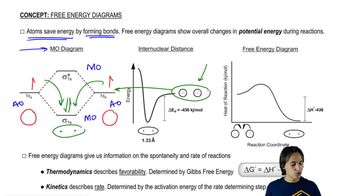
Introduction to free energy diagrams.