Ch. 12 - Substitution and Elimination: Reactions of Haloalkanes
Mullins - Organic Chemistry: A Learner Centered Approach 1st Edition
Mullins1st EditionOrganic Chemistry: A Learner Centered ApproachISBN: 9780137566471Not the one you use?Change textbook
Chapter 11, Problem 29a

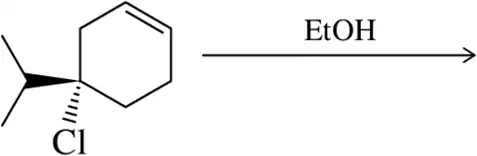
Would you expect the following conditions to favor SN1 or SN2?
(a) Chemical structure showing a chlorine atom on a benzene ring with ethanol as a reagent, indicating a substitution reaction.

Verified step by step guidance
1
Step 1: Understand the difference between Sₙ1 and Sₙ2 mechanisms. Sₙ1 (unimolecular nucleophilic substitution) involves a two-step process where the leaving group departs first, forming a carbocation intermediate, followed by nucleophilic attack. Sₙ2 (bimolecular nucleophilic substitution) is a one-step process where the nucleophile attacks the substrate simultaneously as the leaving group departs.
Step 2: Analyze the substrate structure. Sₙ1 is favored by substrates that can stabilize a carbocation intermediate, such as tertiary carbons or benzylic and allylic carbons. Sₙ2 is favored by substrates with less steric hindrance, such as primary or methyl carbons.
Step 3: Consider the strength of the nucleophile. Sₙ2 is favored by strong nucleophiles because the nucleophile directly participates in the rate-determining step. Sₙ1, on the other hand, is less dependent on nucleophile strength since the rate-determining step is the formation of the carbocation.
Step 4: Evaluate the solvent. Polar protic solvents (e.g., water, alcohols) stabilize carbocations and favor Sₙ1. Polar aprotic solvents (e.g., acetone, DMSO) do not stabilize carbocations as effectively and favor Sₙ2 by enhancing the nucleophilicity of the nucleophile.
Step 5: Assess the leaving group. A good leaving group (e.g., halides like I⁻, Br⁻, or tosylate) is important for both Sₙ1 and Sₙ2, but it is especially critical for Sₙ1 since the leaving group departure is the rate-determining step.

Verified video answer for a similar problem:

This video solution was recommended by our tutors as helpful for the problem above.
Video duration:
3m
Was this helpful?

Key Concepts

Here are the essential concepts you must grasp in order to answer the question correctly.

Nucleophilic Substitution Mechanisms

Nucleophilic substitution reactions can occur via two primary mechanisms: Sₙ1 and Sₙ2. Sₙ1 is a two-step process involving the formation of a carbocation intermediate, while Sₙ2 is a one-step process where the nucleophile attacks the substrate simultaneously as the leaving group departs. Understanding these mechanisms is crucial for predicting the outcome of reactions based on substrate structure and reaction conditions.
Recommended video:
Guided course
01:47
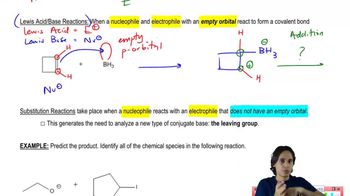
Nucleophiles and Electrophiles can react in Substitution Reactions.

Carbocation Stability

The stability of carbocations plays a significant role in determining whether an Sₙ1 or Sₙ2 mechanism will be favored. More stable carbocations, such as tertiary carbocations, are more likely to form in Sₙ1 reactions, while less stable substrates favor Sₙ2 mechanisms. Factors influencing carbocation stability include the degree of alkyl substitution and resonance effects.
Recommended video:
Guided course
05:58
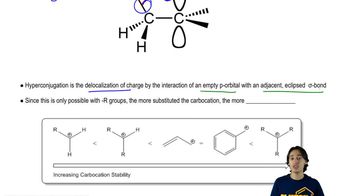
Determining Carbocation Stability

Nucleophile Strength and Solvent Effects

The strength of the nucleophile and the solvent used can significantly influence the preference for Sₙ1 or Sₙ2 mechanisms. Strong nucleophiles and polar aprotic solvents typically favor Sₙ2 reactions, while weak nucleophiles and polar protic solvents can stabilize carbocations, thus favoring Sₙ1. Recognizing these factors helps in predicting the reaction pathway under specific conditions.
Recommended video:
Guided course
13:04
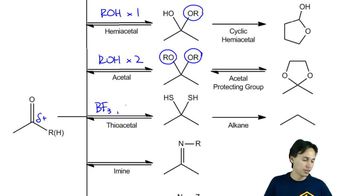
Nucleophilic Addition of Solvents