Ch. 12 - Substitution and Elimination: Reactions of Haloalkanes
Mullins - Organic Chemistry: A Learner Centered Approach 1st Edition
Mullins1st EditionOrganic Chemistry: A Learner Centered ApproachISBN: 9780137566471Not the one you use?Change textbook
Chapter 11, Problem 20c

Would the following nucleophiles be more likely to participate in an SN1 or SN2 reaction?
(c)

Verified step by step guidance
1
Step 1: Analyze the nucleophile provided in the image. The nucleophile is ethyl thiolate (CH3CH2S⁻), which contains a negatively charged sulfur atom. Sulfur is larger and more polarizable compared to oxygen, making it a strong nucleophile.
Step 2: Recall the characteristics of SN1 and SN2 reactions. SN1 reactions involve a carbocation intermediate and are favored by weak nucleophiles and polar protic solvents. SN2 reactions are bimolecular and require strong nucleophiles and polar aprotic solvents.
Step 3: Evaluate the nucleophile's strength. Ethyl thiolate (CH3CH2S⁻) is a strong nucleophile due to its high polarizability and negative charge, which makes it more likely to participate in an SN2 reaction.
Step 4: Consider steric hindrance. SN2 reactions are sensitive to steric hindrance around the electrophilic carbon. Ethyl thiolate is relatively small and does not introduce significant steric hindrance, further favoring SN2 over SN1.
Step 5: Conclude based on the nucleophile's properties. Ethyl thiolate (CH3CH2S⁻) is more likely to participate in an SN2 reaction due to its strong nucleophilicity, low steric hindrance, and preference for a direct attack mechanism.

Verified video answer for a similar problem:

This video solution was recommended by our tutors as helpful for the problem above.
Was this helpful?

Key Concepts

Here are the essential concepts you must grasp in order to answer the question correctly.

Nucleophilicity

Nucleophilicity refers to the ability of a species to donate an electron pair to an electrophile during a chemical reaction. Strong nucleophiles, such as alkyl thiolates, are more likely to participate in nucleophilic substitution reactions. The strength of a nucleophile is influenced by factors such as charge, electronegativity, and steric hindrance.
Recommended video:
Guided course
08:27
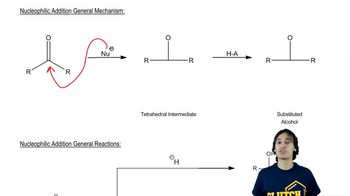
Nucleophilic Addition

S<sub>N</sub>1 and S<sub>N</sub>2 Mechanisms

S<sub>N</sub>1 and S<sub>N</sub>2 are two distinct mechanisms of nucleophilic substitution. S<sub>N</sub>1 is a two-step process involving the formation of a carbocation intermediate, favoring tertiary substrates and weak nucleophiles. In contrast, S<sub>N</sub>2 is a one-step mechanism characterized by a concerted reaction, favoring primary substrates and strong nucleophiles due to steric accessibility.
Recommended video:
Guided course
04:31
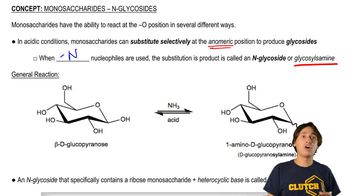
General Reaction

Steric Hindrance

Steric hindrance refers to the repulsion between bulky groups in a molecule that can impede reactions. In nucleophilic substitution, steric hindrance affects the choice between S<sub>N</sub>1 and S<sub>N</sub>2 mechanisms. Bulky nucleophiles or substrates favor S<sub>N</sub>1 reactions, while less hindered substrates allow for S<sub>N</sub>2 reactions, where the nucleophile attacks the electrophile directly.
Recommended video:
Guided course
02:53
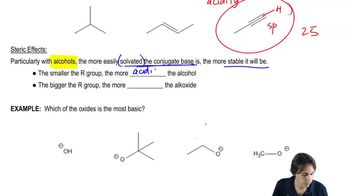
Understanding steric effects.