Ch. 12 - Substitution and Elimination: Reactions of Haloalkanes
Mullins - Organic Chemistry: A Learner Centered Approach 1st Edition
Mullins1st EditionOrganic Chemistry: A Learner Centered ApproachISBN: 9780137566471Not the one you use?Change textbook
Chapter 11, Problem 30c

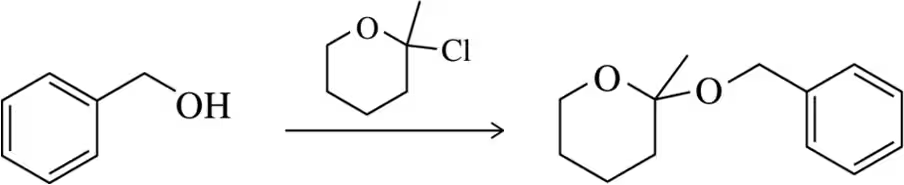
Suggest a mechanism for the following substitution reactions.
(c) Chemical structures illustrating a substitution reaction with reactants and products labeled.

Verified step by step guidance
1
Step 1: Analyze the reactants and products. The reactants include benzyl alcohol (C6H5CH2OH) and a cyclic compound with a chlorine atom attached to an oxygen atom. The product is an ether formed by the substitution of the hydroxyl group in benzyl alcohol with the cyclic group.
Step 2: Identify the type of reaction. This is a substitution reaction where the hydroxyl group (-OH) in benzyl alcohol is replaced by the cyclic group. The reaction likely proceeds via an SN2 mechanism due to the primary nature of the benzyl alcohol and the steric hindrance around the cyclic compound.
Step 3: Protonation of the hydroxyl group. The hydroxyl group in benzyl alcohol may be protonated by an acid catalyst (if present) to form a better leaving group, water (H2O). This step increases the electrophilicity of the benzyl carbon.
Step 4: Nucleophilic attack. The oxygen atom in the cyclic compound acts as a nucleophile and attacks the benzyl carbon, displacing the hydroxyl group (or water if protonated). This step forms the ether bond between the benzyl group and the cyclic group.
Step 5: Formation of the product. The substitution reaction is complete, resulting in the formation of the ether product (C6H5CH2O-cyclic group). Ensure stereochemistry and regioselectivity are considered if applicable.

Verified video answer for a similar problem:

This video solution was recommended by our tutors as helpful for the problem above.
Was this helpful?

Key Concepts

Here are the essential concepts you must grasp in order to answer the question correctly.

Nucleophilic Substitution Reactions

Nucleophilic substitution reactions involve the replacement of a leaving group in a molecule by a nucleophile. In this context, the hydroxyl group (OH) acts as a nucleophile, attacking the electrophilic carbon attached to the chlorine atom in the chlorinated compound. Understanding the mechanism of these reactions, such as whether they proceed via an SN1 or SN2 pathway, is crucial for predicting the outcome of the reaction.
Recommended video:
Guided course
01:47
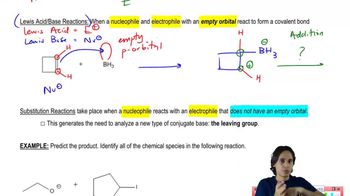
Nucleophiles and Electrophiles can react in Substitution Reactions.

Electrophilic Centers

Electrophilic centers are regions in a molecule that are electron-deficient and can attract nucleophiles. In the provided reaction, the carbon atom bonded to the chlorine atom is an electrophilic center due to the electronegativity of chlorine, which pulls electron density away from the carbon. Recognizing these centers helps in understanding how nucleophiles interact with substrates during substitution reactions.
Recommended video:
Guided course
03:
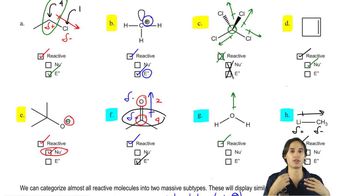
Nucleophile or Electrophile

Reaction Mechanisms

A reaction mechanism describes the step-by-step process by which reactants are converted into products. It includes the formation and breaking of bonds, the movement of electrons, and the intermediates formed during the reaction. For the given substitution reaction, identifying the mechanism (SN1 or SN2) will clarify the order of events and the role of the nucleophile and leaving group, which is essential for predicting the reaction's outcome.
Recommended video:
Guided course
02:16
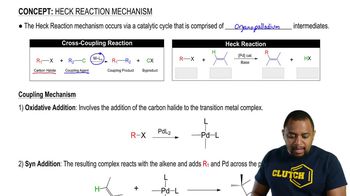
Heck Reaction Mechanism