Ch. 12 - Substitution and Elimination: Reactions of Haloalkanes
Mullins - Organic Chemistry: A Learner Centered Approach 1st Edition
Mullins1st EditionOrganic Chemistry: A Learner Centered ApproachISBN: 9780137566471Not the one you use?Change textbook
Chapter 11, Problem 73a

Suggest a mechanism for the following reactions.
(a) Substitution:
Chemical reaction showing the conversion of an alcohol to a bromide and water using HBr as a reagent.

Verified step by step guidance
1
Step 1: Protonation of the alcohol group (-OH) occurs. The hydroxyl group is a poor leaving group, but in the presence of HBr, the oxygen atom in the -OH group is protonated, forming water (H2O), which is a much better leaving group. This step involves the donation of a proton (H⁺) from HBr to the oxygen atom.
Step 2: Formation of a carbocation intermediate. After protonation, the water molecule leaves, resulting in the formation of a carbocation (positively charged carbon atom). The stability of the carbocation depends on the structure of the molecule; in this case, the carbocation is primary.
Step 3: Nucleophilic attack by bromide ion (Br⁻). The bromide ion, which is generated from the dissociation of HBr, acts as a nucleophile and attacks the carbocation, forming a new C-Br bond.
Step 4: The final product is formed. The substitution reaction results in the formation of the alkyl bromide (CH3CH2Br) and water (H2O) as the byproduct.
Step 5: Verify the reaction type. This reaction is an SN1 mechanism because it involves the formation of a carbocation intermediate, although primary carbocations are less stable and this reaction may proceed via an SN2 mechanism depending on the specific conditions.

Verified video answer for a similar problem:

This video solution was recommended by our tutors as helpful for the problem above.
Was this helpful?

Key Concepts

Here are the essential concepts you must grasp in order to answer the question correctly.

Nucleophilic Substitution

Nucleophilic substitution is a fundamental reaction in organic chemistry where a nucleophile replaces a leaving group in a molecule. In this case, the hydroxyl group (OH) acts as a leaving group when treated with HBr, allowing the bromide ion (Br-) to take its place. Understanding this mechanism is crucial for predicting the products of reactions involving alcohols and halogen acids.
Recommended video:
Guided course
01:47
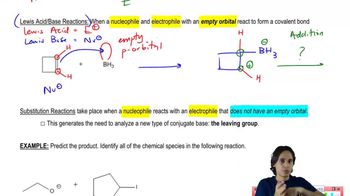
Nucleophiles and Electrophiles can react in Substitution Reactions.

Protonation of Alcohols

Protonation of alcohols is a key step in their conversion to better leaving groups. When an alcohol reacts with a strong acid like HBr, the hydroxyl group is protonated to form water, which is a much better leaving group. This step is essential for facilitating the nucleophilic substitution mechanism, as it enhances the reactivity of the alcohol.
Recommended video:
Guided course
01:01
How to name alcohols

Mechanism of Reaction

The mechanism of a reaction describes the step-by-step process by which reactants are converted into products. In this case, the mechanism involves the protonation of the alcohol followed by the nucleophilic attack of bromide ion on the carbocation formed after the departure of water. Understanding the mechanism helps in predicting the outcome of the reaction and the stability of intermediates.
Recommended video:
Guided course
02:16
Heck Reaction Mechanism