Ch. 12 - Substitution and Elimination: Reactions of Haloalkanes
Mullins - Organic Chemistry: A Learner Centered Approach 1st Edition
Mullins1st EditionOrganic Chemistry: A Learner Centered ApproachISBN: 9780137566471Not the one you use?Change textbook
Chapter 11, Problem 46a

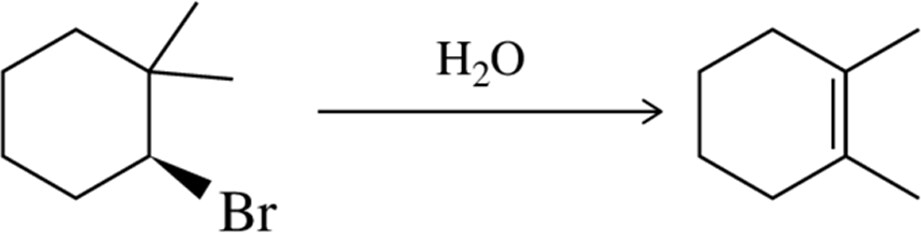
Provide a mechanism for the following E1 reactions.
(a) E1 reaction mechanism showing a brominated cyclohexane converting to a double bond with water as a reagent.

Verified step by step guidance
1
Identify the substrate: In an E1 reaction, the substrate is typically a secondary or tertiary alkyl halide or alcohol. Determine the structure of the starting material to understand the reaction pathway.
Protonation or leaving group departure: If the substrate is an alcohol, protonate the hydroxyl group to convert it into a better leaving group (water). If the substrate already contains a good leaving group (e.g., a halide), this step is not necessary. The leaving group departs, forming a carbocation intermediate.
Carbocation stability: Analyze the carbocation intermediate formed after the leaving group departs. If possible, check for carbocation rearrangements (e.g., hydride or alkyl shifts) to form a more stable carbocation.
Beta-hydrogen elimination: Identify a beta-hydrogen (a hydrogen atom on a carbon adjacent to the carbocation). A base (often the solvent or a weak base) abstracts the beta-hydrogen, and the electrons from the C-H bond form a π-bond, resulting in the formation of the alkene product.
Determine the major product: Use Zaitsev's rule to predict the major product. The more substituted alkene (the one with more alkyl groups attached to the double bond) is typically favored in E1 reactions.

Verified video answer for a similar problem:

This video solution was recommended by our tutors as helpful for the problem above.
Video duration:
1m
Was this helpful?

Key Concepts

Here are the essential concepts you must grasp in order to answer the question correctly.

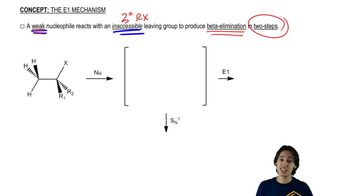
E1 Mechanism

The E1 mechanism, or unimolecular elimination, involves two main steps: the formation of a carbocation intermediate followed by the loss of a leaving group to form a double bond. This process typically occurs in polar protic solvents and is favored by tertiary substrates due to their ability to stabilize the carbocation. Understanding the E1 mechanism is crucial for predicting the products of elimination reactions.
Recommended video:
Guided course
08:09
Drawing the E1 Mechanism.

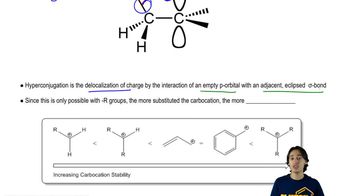
Carbocation Stability

Carbocation stability is a key factor in E1 reactions, as the rate-determining step involves the formation of a carbocation. Tertiary carbocations are more stable than secondary or primary ones due to hyperconjugation and inductive effects from surrounding alkyl groups. Recognizing the stability of different carbocations helps in predicting the likelihood of E1 reactions occurring with specific substrates.
Recommended video:
Guided course
05:58
Determining Carbocation Stability

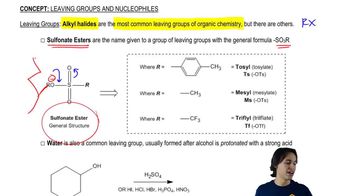
Leaving Groups

The quality of the leaving group significantly influences the rate of E1 reactions. Good leaving groups, such as halides or tosylates, can stabilize the transition state and facilitate the formation of the carbocation. Understanding which groups can effectively leave is essential for determining the feasibility of an E1 reaction and predicting the products formed.
Recommended video:
Guided course
07:22
The 3 important leaving groups to know.