Ch. 12 - Substitution and Elimination: Reactions of Haloalkanes
Mullins - Organic Chemistry: A Learner Centered Approach 1st Edition
Mullins1st EditionOrganic Chemistry: A Learner Centered ApproachISBN: 9780137566471Not the one you use?Change textbook
Chapter 11, Problem 2

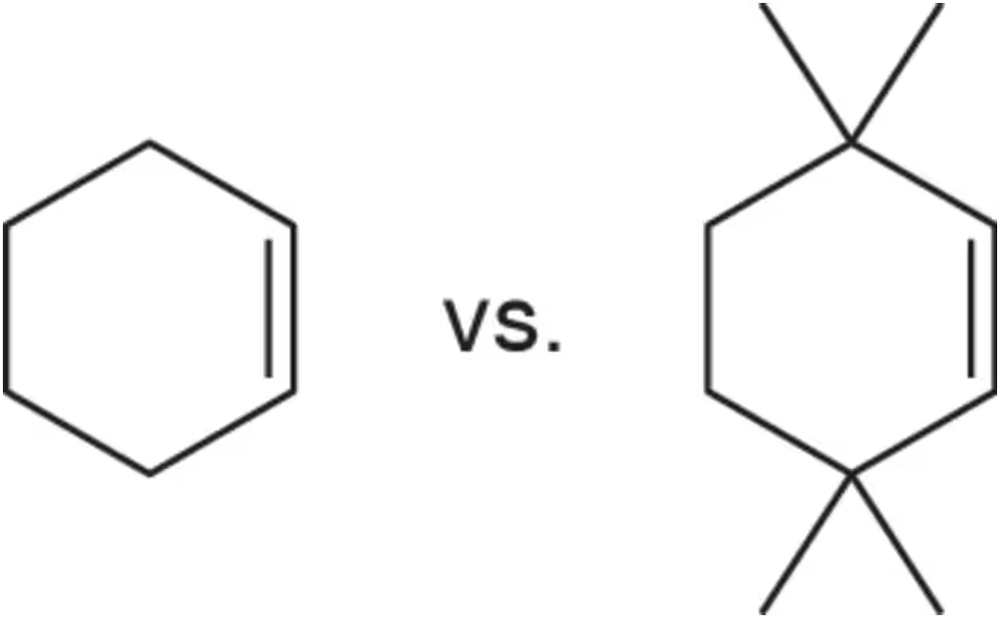
Protonation of which of the following alkenes would be faster?
Two chemical structures of alkenes side by side, with "vs." text in the center, comparing their reactivity.

Verified step by step guidance
1
Step 1: Analyze the structures of the two alkenes provided in the image. Alkene (a) is a simple cyclopentene with two substituents, while alkene (b) is a cyclopentene with multiple bulky substituents (alkyl groups).
Step 2: Recall that protonation of an alkene involves the addition of a proton (H⁺) to the double bond, forming a carbocation intermediate. The stability of the carbocation intermediate plays a key role in determining the rate of protonation.
Step 3: Consider the effect of substituents on carbocation stability. Alkyl groups are electron-donating via hyperconjugation and inductive effects, which stabilize the carbocation. Alkene (b) has more alkyl substituents, which would stabilize the carbocation formed after protonation more effectively than alkene (a).
Step 4: Evaluate steric hindrance. While alkene (b) has more substituents, steric hindrance could slow down the approach of the proton to the double bond. However, the stabilizing effect of the substituents on the carbocation generally outweighs steric hindrance in this case.
Step 5: Conclude that the protonation of alkene (b) is likely to be faster due to the increased stability of the carbocation intermediate formed, despite potential steric hindrance.

Verified video answer for a similar problem:

This video solution was recommended by our tutors as helpful for the problem above.
Video duration:
6m
Was this helpful?

Key Concepts

Here are the essential concepts you must grasp in order to answer the question correctly.

Protonation of Alkenes

Protonation of alkenes involves the addition of a proton (H+) to the double bond, forming a carbocation. The stability of the resulting carbocation significantly influences the rate of protonation. More stable carbocations, such as tertiary or resonance-stabilized ones, will form more quickly than less stable primary or secondary carbocations.
Recommended video:
2:09
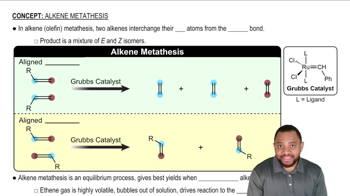
Alkene Metathesis Concept 1

Carbocation Stability

Carbocation stability is determined by the degree of alkyl substitution and resonance effects. Tertiary carbocations are more stable than secondary, which are more stable than primary due to hyperconjugation and inductive effects from surrounding alkyl groups. Additionally, resonance can stabilize carbocations by delocalizing the positive charge over multiple atoms.
Recommended video:
Guided course
05:58
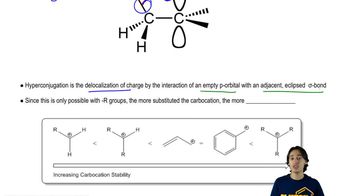
Determining Carbocation Stability

Steric Hindrance

Steric hindrance refers to the repulsion between atoms that occurs when they are brought close together, affecting the reactivity of molecules. In the context of alkenes, bulky substituents can hinder the approach of protons during protonation, influencing the rate at which different alkenes undergo protonation. Less sterically hindered alkenes will generally react faster.
Recommended video:
Guided course
02:53
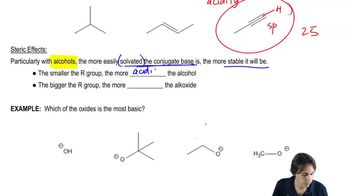
Understanding steric effects.