Ch. 12 - Substitution and Elimination: Reactions of Haloalkanes
Mullins - Organic Chemistry: A Learner Centered Approach 1st Edition
Mullins1st EditionOrganic Chemistry: A Learner Centered ApproachISBN: 9780137566471Not the one you use?Change textbook
Chapter 11, Problem 56a

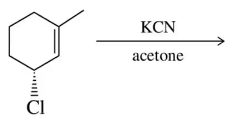
Predict the product(s) of the following substitution or elimination reactions, paying close attention to the stereochemical outcome of the reactions.
(a)

Verified step by step guidance
1
Step 1: Analyze the given reaction conditions. The substrate is a cyclohexyl chloride with a double bond and a methyl group. The reagent is potassium cyanide (KCN) in acetone, which is a polar aprotic solvent. This suggests that the reaction will likely proceed via an SN2 mechanism.
Step 2: Consider the stereochemistry of the substrate. The chlorine atom is attached to the cyclohexane ring in a wedge (out of the plane), indicating its stereochemical orientation. In an SN2 reaction, the nucleophile attacks from the opposite side of the leaving group, leading to an inversion of configuration.
Step 3: Identify the nucleophile and leaving group. The cyanide ion (CN⁻) is the nucleophile, and the chloride ion (Cl⁻) is the leaving group. The cyanide ion will attack the carbon bonded to the chlorine, displacing the chloride ion.
Step 4: Predict the product. The cyanide ion will replace the chlorine atom, and due to the SN2 mechanism, the stereochemistry at the carbon center will invert. The CN group will now be in the opposite stereochemical orientation (dash, into the plane).
Step 5: Verify the reaction type and stereochemical outcome. Since the reaction occurs in a polar aprotic solvent and involves a strong nucleophile, the SN2 mechanism is confirmed. The product will be a cyclohexane ring with a double bond, a methyl group, and a cyanide group in the inverted stereochemical position.

Verified video answer for a similar problem:

This video solution was recommended by our tutors as helpful for the problem above.
Video duration:
4m
Was this helpful?

Key Concepts

Here are the essential concepts you must grasp in order to answer the question correctly.

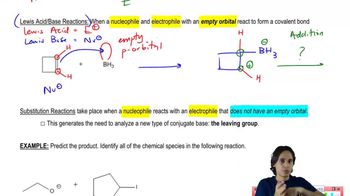
Nucleophilic Substitution Reactions

Nucleophilic substitution reactions involve the replacement of a leaving group in a molecule by a nucleophile. These reactions can occur via two main mechanisms: SN1, which is a two-step process involving carbocation formation, and SN2, which is a one-step process where the nucleophile attacks the substrate simultaneously as the leaving group departs. Understanding the mechanism is crucial for predicting the products and their stereochemistry.
Recommended video:
Guided course
01:47
Nucleophiles and Electrophiles can react in Substitution Reactions.

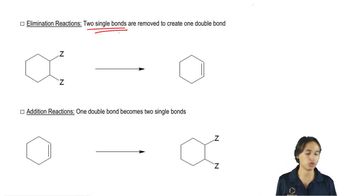
Elimination Reactions

Elimination reactions involve the removal of a leaving group and a hydrogen atom from adjacent carbon atoms, resulting in the formation of a double bond. The two primary types are E1, which proceeds through a carbocation intermediate, and E2, which is a concerted mechanism. The choice between substitution and elimination often depends on the structure of the substrate and the reaction conditions.
Recommended video:
Guided course
00:40
Recognizing Elimination Reactions.

Stereochemistry

Stereochemistry refers to the spatial arrangement of atoms in molecules and how this affects their chemical behavior. In substitution and elimination reactions, the stereochemical outcome can lead to different isomers, such as cis/trans or R/S configurations. Recognizing the stereochemical implications is essential for accurately predicting the products of these reactions, especially in chiral environments.
Recommended video:
1:38
Polymer Stereochemistry Concept 1