Ch. 12 - Substitution and Elimination: Reactions of Haloalkanes
Mullins - Organic Chemistry: A Learner Centered Approach 1st Edition
Mullins1st EditionOrganic Chemistry: A Learner Centered ApproachISBN: 9780137566471Not the one you use?Change textbook
Chapter 11, Problem 54a

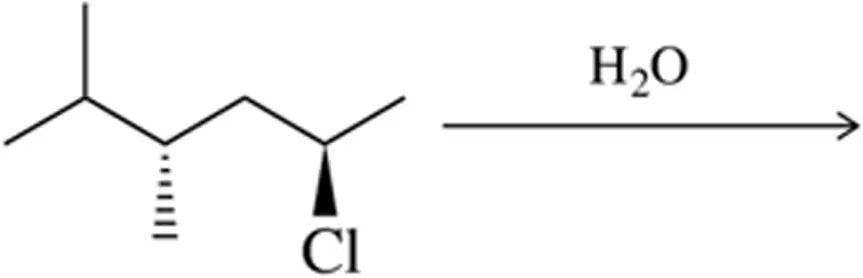
Predict the product of the following substitution reactions, paying close attention to the stereochemical outcome of the reactions.
(a) Chemical structure showing a chlorine atom on a carbon chain with water as a reactant, indicating a substitution reaction.

Verified step by step guidance
1
Analyze the type of substitution reaction: Determine whether the reaction is SN1 or SN2. This depends on factors such as the structure of the substrate (primary, secondary, or tertiary carbon), the strength of the nucleophile, and the solvent (polar protic or polar aprotic).
Examine the substrate: If the carbon attached to the leaving group is primary, the reaction is likely SN2. If it is tertiary, the reaction is likely SN1. For secondary carbons, consider the nucleophile and solvent to decide.
Consider the stereochemical implications: For SN2 reactions, the nucleophile attacks from the opposite side of the leaving group, leading to an inversion of configuration at the stereocenter. For SN1 reactions, a planar carbocation intermediate is formed, allowing the nucleophile to attack from either side, resulting in a racemic mixture if the carbon is chiral.
Identify the leaving group: Ensure the leaving group is good (e.g., halides like Cl⁻, Br⁻, or I⁻). A poor leaving group may hinder the reaction.
Predict the product: Based on the mechanism (SN1 or SN2), draw the product, ensuring to account for stereochemical changes (inversion for SN2 or racemization for SN1) and the substitution of the leaving group with the nucleophile.

Verified video answer for a similar problem:

This video solution was recommended by our tutors as helpful for the problem above.
Video duration:
3m
Was this helpful?

Key Concepts

Here are the essential concepts you must grasp in order to answer the question correctly.

Nucleophilic Substitution Mechanisms

Nucleophilic substitution reactions involve the replacement of a leaving group by a nucleophile. The two primary mechanisms are SN1 and SN2. SN1 is a two-step process where the leaving group departs first, forming a carbocation, followed by nucleophilic attack. In contrast, SN2 is a one-step process where the nucleophile attacks the substrate simultaneously as the leaving group departs, leading to an inversion of configuration at the chiral center.
Recommended video:
Guided course
01:47
Nucleophiles and Electrophiles can react in Substitution Reactions.

Stereochemistry

Stereochemistry refers to the spatial arrangement of atoms in molecules and how this affects their chemical behavior. In substitution reactions, the stereochemical outcome is crucial, especially in chiral centers. SN2 reactions result in inversion of configuration, while SN1 reactions can lead to racemization due to the planar nature of the carbocation intermediate, allowing nucleophiles to attack from either side.
Recommended video:
1:38
Polymer Stereochemistry Concept 1

Leaving Groups

A leaving group is an atom or group that can depart from the parent molecule during a chemical reaction. Good leaving groups are typically stable after departure, such as halides or sulfonate esters. The ability of a leaving group to stabilize the negative charge influences the reaction rate and mechanism, making it a critical factor in predicting the products of substitution reactions.
Recommended video:
Guided course
07:22
The 3 important leaving groups to know.