Ch. 12 - Substitution and Elimination: Reactions of Haloalkanes
Mullins - Organic Chemistry: A Learner Centered Approach 1st Edition
Mullins1st EditionOrganic Chemistry: A Learner Centered ApproachISBN: 9780137566471Not the one you use?Change textbook
Chapter 11, Problem 11a

Practice your electron-pushing skills by drawing a mechanism for the following SN2 reactions.
(a) Chemical reaction diagram showing an SN2 reaction with sodium cyanide in DMSO, converting bromobenzene to benzonitrile.

Verified step by step guidance
1
Identify the key components of the Sₙ2 reaction: the nucleophile, the electrophile (substrate), and the leaving group. The nucleophile is typically a species with a lone pair or a negative charge, while the electrophile is a carbon atom bonded to a good leaving group.
Recognize that the Sₙ2 mechanism is a single-step process where the nucleophile attacks the electrophilic carbon from the opposite side of the leaving group, leading to a backside attack. This results in an inversion of configuration at the carbon center (if it is chiral).
Draw the curved arrow mechanism: Start the arrow at the lone pair or negative charge of the nucleophile and point it toward the electrophilic carbon. Simultaneously, draw another arrow from the bond between the carbon and the leaving group to the leaving group itself, indicating that the leaving group departs as the nucleophile bonds to the carbon.
Ensure that the transition state is depicted if required. The transition state in an Sₙ2 reaction is a high-energy, pentavalent structure where the nucleophile is partially bonded to the carbon, and the leaving group is partially detached.
Finally, draw the products of the reaction: the new molecule formed after the nucleophile has replaced the leaving group, and the leaving group itself as a separate species. Confirm that the stereochemistry of the product reflects the inversion of configuration at the carbon center (if applicable).

Verified video answer for a similar problem:

This video solution was recommended by our tutors as helpful for the problem above.
Video duration:
2m
Was this helpful?

Key Concepts

Here are the essential concepts you must grasp in order to answer the question correctly.

Sₙ2 Mechanism

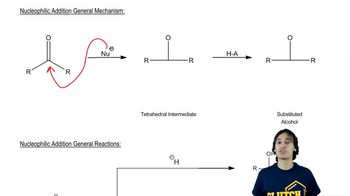
The Sₙ2 (substitution nucleophilic bimolecular) mechanism involves a nucleophile attacking an electrophile, resulting in the simultaneous displacement of a leaving group. This reaction occurs in a single concerted step, meaning that bond formation and bond breaking happen simultaneously. The reaction rate depends on the concentration of both the nucleophile and the substrate, making it bimolecular.
Recommended video:
Guided course
04:32
General Mechanism

Nucleophiles

Nucleophiles are species that donate an electron pair to form a chemical bond in a reaction. They are typically negatively charged or neutral molecules with lone pairs of electrons, which allow them to attack positively polarized atoms in electrophiles. Understanding the strength and reactivity of different nucleophiles is crucial for predicting the outcome of Sₙ2 reactions.
Recommended video:
Guided course
08:27
Nucleophilic Addition

Leaving Groups

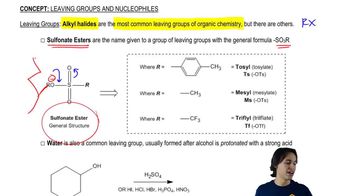
Leaving groups are atoms or groups that can depart from the substrate during a chemical reaction, taking with them the electrons from the bond they formed with the substrate. A good leaving group is typically stable after departure, such as halides or sulfonate groups. The ability of a leaving group to stabilize its negative charge is a key factor in the efficiency of Sₙ2 reactions.
Recommended video:
Guided course
07:22
The 3 important leaving groups to know.