Ch. 12 - Substitution and Elimination: Reactions of Haloalkanes
Mullins - Organic Chemistry: A Learner Centered Approach 1st Edition
Mullins1st EditionOrganic Chemistry: A Learner Centered ApproachISBN: 9780137566471Not the one you use?Change textbook
Chapter 11, Problem 17

Order the following molecules on the basis of their nucleophilic strength using the pKₐ values of their conjugate acids.
Molecules displaying hydroxide, alkoxide, amine, and carboxylate groups for nucleophilic strength comparison.

Verified step by step guidance
1
Step 1: Understand the relationship between nucleophilicity and the pKₐ values of the conjugate acids. Nucleophilicity is influenced by the basicity of the molecule, which can be inferred from the pKₐ of its conjugate acid. A higher pKₐ value indicates a weaker conjugate acid and a stronger base, which typically corresponds to higher nucleophilicity.
Step 2: Identify the conjugate acids of the given molecules. For ethanol (CH₃CH₂OH), the conjugate acid is ethanol itself. For ethoxide (CH₃CH₂O⁻), the conjugate acid is ethanol (CH₃CH₂OH). For ethylamine (CH₃CH₂NH₂), the conjugate acid is ethylammonium ion (CH₃CH₂NH₃⁺). For acetate ion (CH₃COO⁻), the conjugate acid is acetic acid (CH₃COOH).
Step 3: Research or recall the approximate pKₐ values of the conjugate acids: Ethanol has a pKₐ of around 16, ethylammonium ion has a pKₐ of around 10.6, and acetic acid has a pKₐ of around 4.8. Ethoxide is the conjugate base of ethanol, so its nucleophilicity is related to ethanol's pKₐ.
Step 4: Compare the pKₐ values to determine nucleophilic strength. Molecules with higher pKₐ values of their conjugate acids are stronger nucleophiles. Based on the pKₐ values: Ethoxide (CH₃CH₂O⁻) > Ethylamine (CH₃CH₂NH₂) > Acetate ion (CH₃COO⁻). Ethanol (CH₃CH₂OH) is neutral and less nucleophilic compared to the charged species.
Step 5: Order the molecules based on nucleophilic strength: Ethoxide (CH₃CH₂O⁻) is the strongest nucleophile, followed by ethylamine (CH₃CH₂NH₂), then acetate ion (CH₃COO⁻), and finally ethanol (CH₃CH₂OH) as the weakest nucleophile.

Verified video answer for a similar problem:

This video solution was recommended by our tutors as helpful for the problem above.
Was this helpful?

Key Concepts

Here are the essential concepts you must grasp in order to answer the question correctly.

Nucleophilicity

Nucleophilicity refers to the ability of a species to donate an electron pair to an electrophile, forming a chemical bond. It is influenced by factors such as charge, electronegativity, and steric hindrance. Stronger nucleophiles are typically negatively charged or have lone pairs that can be readily donated.
Recommended video:
Guided course
08:27
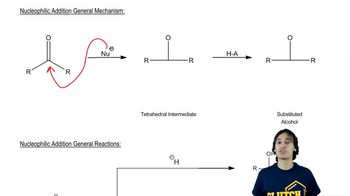
Nucleophilic Addition

pKₐ and Conjugate Acids

pKₐ is a measure of the acidity of a compound, indicating the strength of its conjugate acid. A lower pKₐ value corresponds to a stronger acid, which means its conjugate base is a stronger nucleophile. Thus, comparing the pKₐ values of conjugate acids helps determine the relative nucleophilic strength of their corresponding bases.
Recommended video:
Guided course
03:27
Conjugated states

Order of Nucleophiles

To order nucleophiles based on their strength, one can analyze the pKₐ values of their conjugate acids. The nucleophile with the highest pKₐ of its conjugate acid is the strongest nucleophile, as it indicates a weaker acid and a more stable conjugate base. This relationship allows for systematic comparison of nucleophilic strength among different species.
Recommended video:
Guided course
08:27
Nucleophilic Addition