Ch. 11 - Properties and Synthesis of Alkyl Halides: Radical Reactions
Mullins - Organic Chemistry: A Learner Centered Approach 1st Edition
Mullins1st EditionOrganic Chemistry: A Learner Centered ApproachISBN: 9780137566471Not the one you use?Change textbook
Chapter 10, Problem 10e

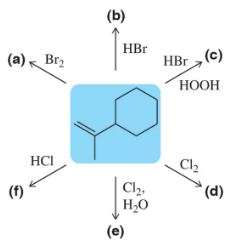
Predict the product of the following haloalkane syntheses.
(e)

Verified step by step guidance
1
Step 1: Analyze the given reactant structure. The molecule is a cyclohexane ring with a double bond (alkene) attached to a methyl group. This is a substituted alkene, which will undergo electrophilic addition reactions.
Step 2: Focus on the reaction labeled (e), which involves Cl₂ and H₂O. This is a halohydrin formation reaction. In this reaction, the alkene reacts with chlorine in the presence of water to form a halohydrin.
Step 3: Understand the mechanism of halohydrin formation. The alkene undergoes electrophilic addition with Cl₂, forming a cyclic chloronium ion intermediate. Water then attacks the more substituted carbon of the intermediate, leading to the formation of the halohydrin.
Step 4: Predict the regioselectivity of the reaction. Water will preferentially attack the more substituted carbon due to the stability of the carbocation-like transition state. This results in the hydroxyl group (-OH) attaching to the more substituted carbon and the chlorine atom attaching to the less substituted carbon.
Step 5: Draw the product structure. The final product will have a hydroxyl group (-OH) on the more substituted carbon of the original double bond and a chlorine atom (Cl) on the less substituted carbon. Ensure stereochemistry is considered if applicable.

Verified video answer for a similar problem:

This video solution was recommended by our tutors as helpful for the problem above.
Was this helpful?

Key Concepts

Here are the essential concepts you must grasp in order to answer the question correctly.

Haloalkanes

Haloalkanes, or alkyl halides, are organic compounds containing carbon, hydrogen, and halogen atoms. They are characterized by the presence of a carbon-halogen bond, which can undergo various reactions, including nucleophilic substitution and elimination. Understanding the structure and reactivity of haloalkanes is crucial for predicting the products of their chemical reactions.

Halogenation

Halogenation is a chemical reaction that involves the introduction of halogen atoms into a molecule. In the context of haloalkanes, halogenation typically refers to the reaction of alkanes with halogens, such as chlorine (Cl₂), under specific conditions. This process can lead to the formation of haloalkanes and is essential for understanding how to predict the products of reactions involving haloalkanes.
Recommended video:
Guided course
03:45
Halogenation Mechanism

Nucleophilic Substitution

Nucleophilic substitution is a fundamental reaction mechanism in organic chemistry where a nucleophile replaces a leaving group in a molecule. In the case of haloalkanes, water (H₂O) can act as a nucleophile, attacking the carbon atom bonded to the halogen and resulting in the formation of an alcohol. Recognizing this mechanism is key to predicting the products of reactions involving haloalkanes and nucleophiles.
Recommended video:
Guided course
01:47
Nucleophiles and Electrophiles can react in Substitution Reactions.