Ch. 11 - Properties and Synthesis of Alkyl Halides: Radical Reactions
Mullins - Organic Chemistry: A Learner Centered Approach 1st Edition
Mullins1st EditionOrganic Chemistry: A Learner Centered ApproachISBN: 9780137566471Not the one you use?Change textbook
Chapter 10, Problem 7.20a,c

Suppose you intend to synthesize the secondary alkyl halide from each reaction shown.
(a) What is the atom economy of each reaction?
(c) Which reaction would you consider greener? Why?

Verified step by step guidance
1
Step 1: Understand the concept of atom economy. Atom economy is a measure of the efficiency of a chemical reaction in terms of how well atoms are utilized. It is calculated using the formula: \( \text{Atom Economy} = \frac{\text{Molar mass of desired product}}{\text{Total molar mass of all products}} \times 100 \).
Step 2: Analyze the first reaction involving chlorine. The desired product is 2-chloropropane, and the by-product is 1-chloropropane. Calculate the molar masses of both products and use the atom economy formula to determine the atom economy for the formation of 2-chloropropane.
Step 3: Analyze the second reaction involving bromine. The desired product is 2-bromopropane, and the by-product is 1-bromopropane. Calculate the molar masses of both products and use the atom economy formula to determine the atom economy for the formation of 2-bromopropane.
Step 4: Compare the atom economies of both reactions. A higher atom economy indicates a more efficient use of atoms in the reaction, which is a key factor in determining the 'greenness' of a reaction.
Step 5: Consider other factors that contribute to the greenness of a reaction, such as the selectivity of the reaction, the percentage yield of the desired product, and the environmental impact of the reagents used. Based on the image, the reaction with bromine has a higher selectivity for the desired product (97% for 2-bromopropane) compared to the chlorine reaction (60% for 2-chloropropane), suggesting it may be considered greener.

Verified video answer for a similar problem:

This video solution was recommended by our tutors as helpful for the problem above.
Video duration:
13m
Was this helpful?

Key Concepts

Here are the essential concepts you must grasp in order to answer the question correctly.

Atom Economy

Atom economy is a measure of the efficiency of a chemical reaction in terms of how well atoms in the reactants are utilized in the desired product. It is calculated by dividing the molecular weight of the desired product by the total molecular weight of all products, multiplied by 100. A higher atom economy indicates a more efficient and environmentally friendly process.
Recommended video:
Guided course
01:44
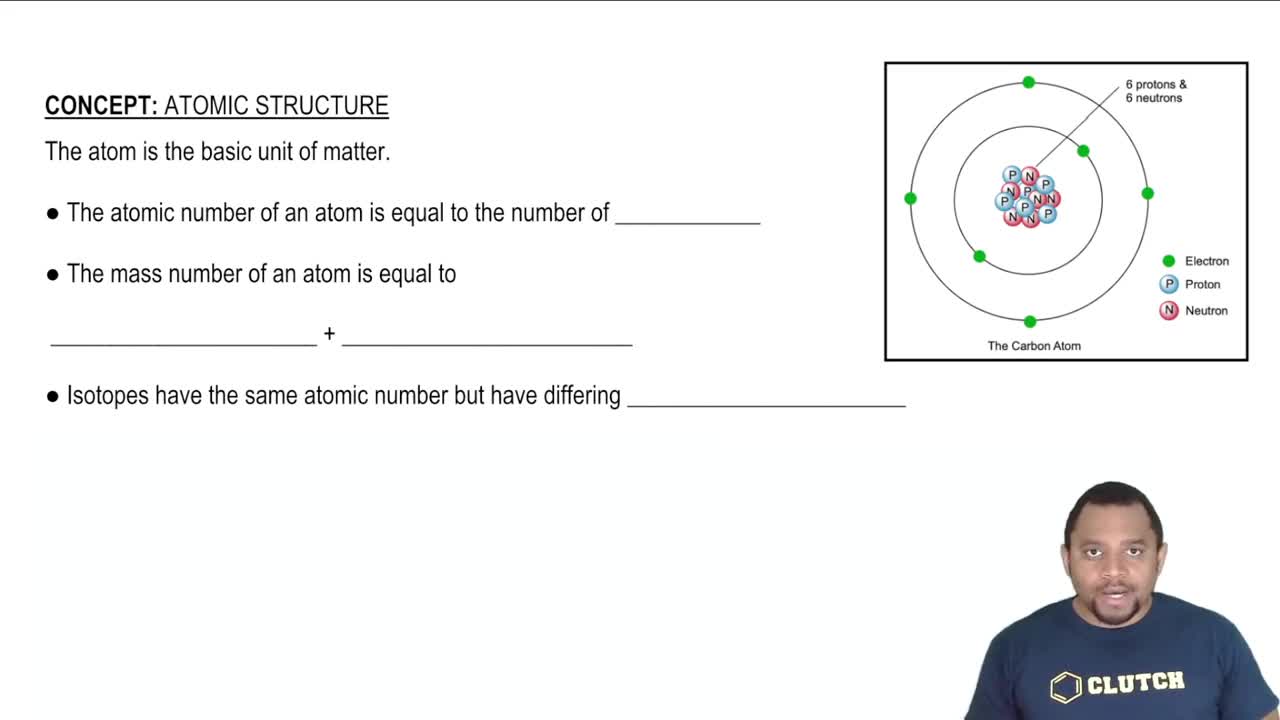
The difference between atomic numbers and atomic mass.

Selectivity in Halogenation

Selectivity in halogenation refers to the preference of a reaction to produce one isomer over another. In the given reactions, bromination shows higher selectivity for forming 2-bromopropane (97%) compared to chlorination, which forms 2-chloropropane (60%). This selectivity is influenced by factors such as bond strength and reaction conditions, impacting the yield and efficiency of the synthesis.
Recommended video:
Guided course
03:45
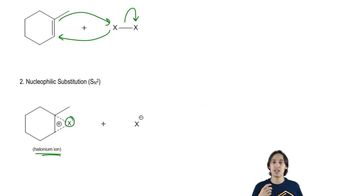
Halogenation Mechanism

Green Chemistry

Green chemistry aims to design chemical processes that reduce or eliminate the use and generation of hazardous substances. A greener reaction minimizes waste, uses safer reagents, and has a higher atom economy. In the context of the question, the bromination reaction is considered greener due to its higher selectivity and atom economy, resulting in less waste and more efficient use of resources.
Recommended video:
Guided course
00:28
Introduction to General Chemistry Review