Ch. 11 - Properties and Synthesis of Alkyl Halides: Radical Reactions
Mullins - Organic Chemistry: A Learner Centered Approach 1st Edition
Mullins1st EditionOrganic Chemistry: A Learner Centered ApproachISBN: 9780137566471Not the one you use?Change textbook
Chapter 10, Problem 42b

In each pair,
(i) choose the compound that is most soluble in water.
(ii) Within each pair, which is most soluble in nonpolar solvents?
(b) Chemical structures comparing solubility: one with an -OH group and the other with a -Cl group.

Verified step by step guidance
1
Step 1: Understand the solubility principles. Water is a polar solvent, so compounds that are polar or can form hydrogen bonds with water are more soluble in water. Nonpolar solvents dissolve nonpolar compounds due to similar intermolecular forces (like dissolves like).
Step 2: Analyze the functional groups in the compounds. Look for polar groups (e.g., -OH, -NH2, -COOH) or the ability to form hydrogen bonds for water solubility. For nonpolar solvents, look for nonpolar characteristics such as long hydrocarbon chains or lack of polar functional groups.
Step 3: Compare the two compounds in each pair. Identify which compound has more polar functional groups or hydrogen-bonding capability for water solubility. For nonpolar solvents, identify which compound has more nonpolar characteristics.
Step 4: Consider the molecular structure and size. Smaller polar molecules are generally more soluble in water, while larger nonpolar molecules are more soluble in nonpolar solvents.
Step 5: Conclude the comparison for each pair based on the above analysis, specifying which compound is more soluble in water and which is more soluble in nonpolar solvents.

Verified video answer for a similar problem:

This video solution was recommended by our tutors as helpful for the problem above.
Video duration:
2m
Was this helpful?

Key Concepts

Here are the essential concepts you must grasp in order to answer the question correctly.

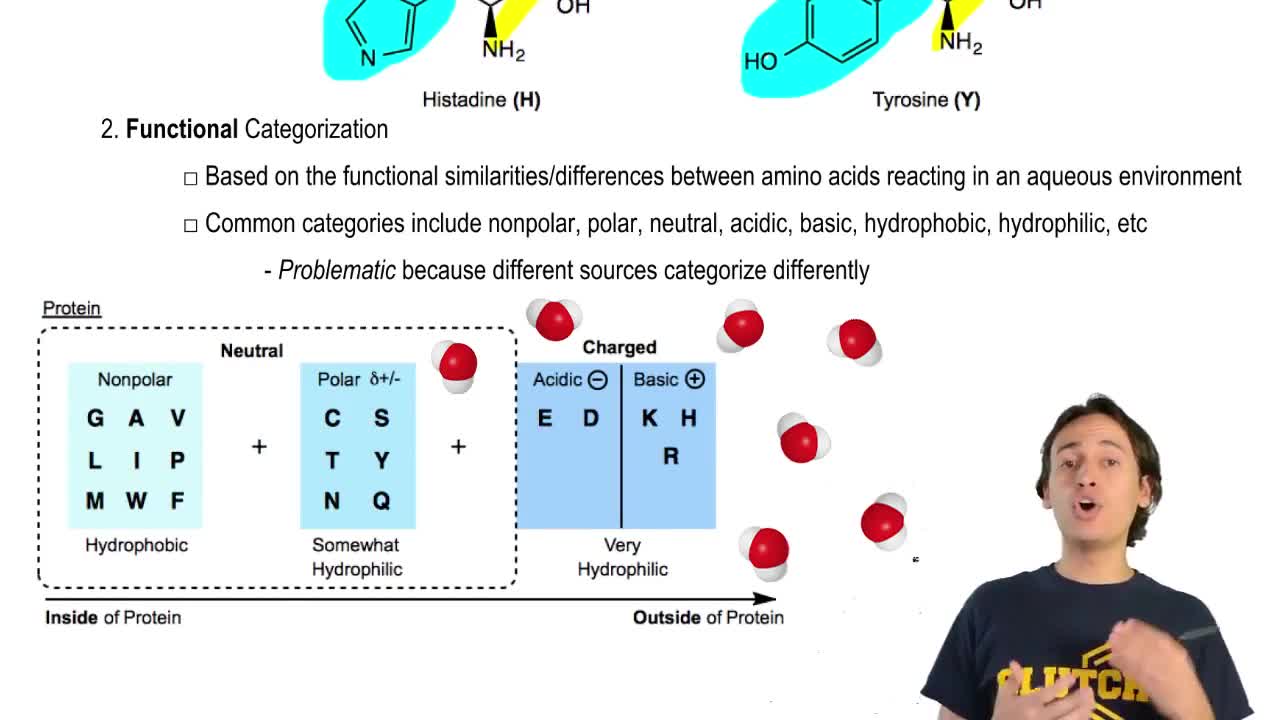
Polarity and Solubility

Polarity refers to the distribution of electrical charge over the atoms in a molecule. Polar molecules, which have a significant difference in electronegativity between atoms, tend to dissolve well in polar solvents like water. Conversely, nonpolar molecules, which have an even distribution of charge, are more soluble in nonpolar solvents. Understanding the polarity of compounds is essential for predicting their solubility behavior.
Recommended video:
Guided course
07:13
Functional Classification

Hydrogen Bonding

Hydrogen bonding is a type of strong dipole-dipole interaction that occurs when hydrogen is bonded to highly electronegative atoms like oxygen, nitrogen, or fluorine. This interaction significantly increases the solubility of compounds in water, as water itself is a polar solvent capable of forming hydrogen bonds. Recognizing which compounds can form hydrogen bonds helps in determining their solubility in aqueous environments.
Recommended video:
Guided course
00:48
The definition of hydrogenation.

Like Dissolves Like Principle

The 'like dissolves like' principle states that polar solvents dissolve polar solutes, while nonpolar solvents dissolve nonpolar solutes. This concept is fundamental in organic chemistry for predicting solubility patterns. When comparing compounds, identifying their polarity allows for a clear understanding of which will be more soluble in water versus nonpolar solvents, guiding the selection process in the question.
Recommended video:
Guided course
01:47
Understanding “like dissolves like”.