Ch. 11 - Properties and Synthesis of Alkyl Halides: Radical Reactions
Mullins - Organic Chemistry: A Learner Centered Approach 1st Edition
Mullins1st EditionOrganic Chemistry: A Learner Centered ApproachISBN: 9780137566471Not the one you use?Change textbook
Chapter 10, Problem 51a

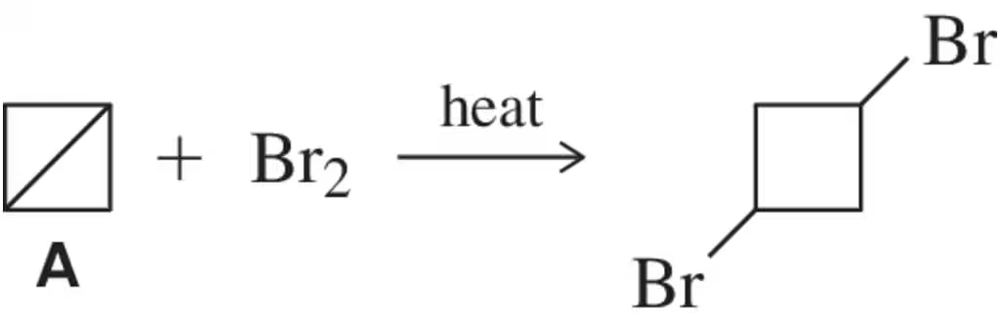
For the following reaction, answer questions (a)–(d).
Chemical reaction: square A plus Br2 under heat yields square with two Br atoms attached.
(a) Give an arrow-pushing mechanism, including the initiation step and two propagation steps.

Verified step by step guidance
1
Identify the type of reaction: The reaction involves the addition of bromine (Br₂) to a cyclobutane ring under heat, indicating a radical halogenation process.
Initiation step: Heat causes the homolytic cleavage of the Br-Br bond in Br₂, generating two bromine radicals. This can be represented as: Br2Br+Br
First propagation step: A bromine radical abstracts a hydrogen atom from the cyclobutane ring, forming HBr and a cyclobutane radical. This can be represented as: Br+CHHBr+C
Second propagation step: The cyclobutane radical reacts with another Br₂ molecule, forming the brominated cyclobutane product and regenerating a bromine radical. This can be represented as: C+Br2CBr+Br
Review the mechanism: Ensure that the initiation and propagation steps are correctly balanced and that the radical intermediates are properly accounted for in the mechanism.

Verified video answer for a similar problem:

This video solution was recommended by our tutors as helpful for the problem above.
Was this helpful?

Key Concepts

Here are the essential concepts you must grasp in order to answer the question correctly.

Radical Halogenation

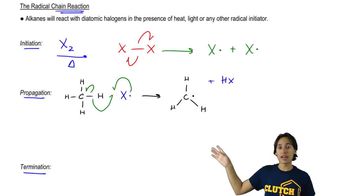
Radical halogenation is a reaction where halogens, such as bromine, react with organic compounds to form radicals. This process typically involves initiation, propagation, and termination steps. In the initiation step, heat or light causes the homolytic cleavage of the Br-Br bond, generating bromine radicals that can react with the organic substrate.
Recommended video:
Guided course
12:11
Radical Chain Reaction Mechanism.

Arrow-Pushing Mechanism

Arrow-pushing is a technique used to illustrate the movement of electrons during chemical reactions. It involves using curved arrows to show how electron pairs are transferred between atoms or molecules. In radical reactions, single-headed arrows are used to depict the movement of single electrons, which is crucial for understanding the initiation and propagation steps in radical halogenation.
Recommended video:
Guided course
04:32
General Mechanism

Cyclobutane Reactivity

Cyclobutane is a four-membered ring that can undergo reactions due to its ring strain and relatively high energy. In radical halogenation, the bromine radicals can attack the cyclobutane ring, leading to the formation of brominated products. Understanding the reactivity of cyclobutane is essential for predicting the outcome of the reaction and the formation of specific products.
Recommended video:
Guided course
01:17
Reactivity of Molecules