Ch. 11 - Properties and Synthesis of Alkyl Halides: Radical Reactions
Mullins - Organic Chemistry: A Learner Centered Approach 1st Edition
Mullins1st EditionOrganic Chemistry: A Learner Centered ApproachISBN: 9780137566471Not the one you use?Change textbook
Chapter 10, Problem 38b

Draw the structure that corresponds to the compound names shown.
(b) (5R,6E)-5-bromooct-6-en-1-yne

Verified step by step guidance
1
Step 1: Break down the compound name systematically. The name '(5R,6E)-5-bromooct-6-en-1-yne' provides stereochemical, structural, and functional group information. The 'oct' indicates an 8-carbon chain, '6-en' specifies a double bond at the 6th carbon, and '1-yne' specifies a triple bond at the 1st carbon. The '5-bromo' indicates a bromine substituent at the 5th carbon. The '(5R,6E)' specifies stereochemistry: 'R' for the 5th carbon and 'E' for the double bond at the 6th carbon.
Step 2: Begin constructing the carbon backbone. Draw an 8-carbon chain (octane backbone) and number the carbons from 1 to 8. Ensure the numbering starts from the end closest to the triple bond (1-yne) to follow IUPAC rules for prioritizing functional groups.
Step 3: Add the functional groups. Place a triple bond between carbons 1 and 2 (1-yne) and a double bond between carbons 6 and 7 (6-en). Ensure the double bond is in the 'E' configuration, meaning the highest priority groups on either side of the double bond are on opposite sides.
Step 4: Add the substituent. Attach a bromine atom to the 5th carbon (5-bromo). Ensure the stereochemistry at the 5th carbon is 'R'. To determine 'R' configuration, assign priorities to the groups attached to the 5th carbon based on atomic number and orientation, then arrange them accordingly.
Step 5: Verify the structure. Double-check that the structure matches all aspects of the name, including the correct number of carbons, placement of the triple and double bonds, substituent location, and stereochemistry ('R' and 'E').

Verified video answer for a similar problem:

This video solution was recommended by our tutors as helpful for the problem above.
Video duration:
9m
Was this helpful?

Key Concepts

Here are the essential concepts you must grasp in order to answer the question correctly.

Stereochemistry

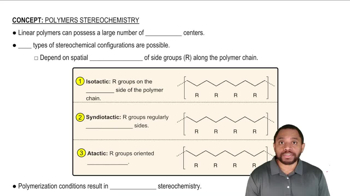
Stereochemistry is the study of the spatial arrangement of atoms in molecules and how this affects their chemical properties and reactions. In the given compound name, the '5R' indicates a specific stereochemical configuration at the fifth carbon, which is crucial for accurately drawing the structure. Understanding stereochemistry is essential for distinguishing between different isomers that may have the same molecular formula but different spatial arrangements.
Recommended video:
1:38
Polymer Stereochemistry Concept 1

Nomenclature of Organic Compounds

Nomenclature refers to the systematic naming of organic compounds based on established rules. The name '(5R,6E)-5-bromooct-6-en-1-yne' provides information about the compound's structure, including the presence of a bromine substituent, the location of double and triple bonds, and the overall carbon chain length. Familiarity with IUPAC nomenclature is vital for interpreting compound names and translating them into structural representations.
Recommended video:
Guided course
01:40
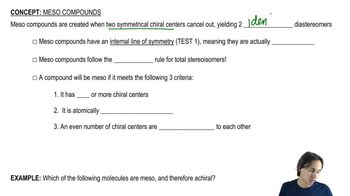
Defining meso compounds.

Functional Groups

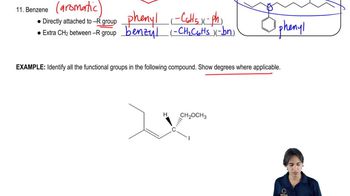
Functional groups are specific groups of atoms within molecules that are responsible for the characteristic chemical reactions of those molecules. In the compound name, 'bromo' indicates the presence of a bromine atom, while 'en' and 'yne' denote the presence of double and triple bonds, respectively. Recognizing functional groups is essential for predicting the reactivity and properties of organic compounds, as they dictate how the molecule will behave in chemical reactions.
Recommended video:
Guided course
02:36
Identifying Functional Groups