Ch. 10 - Alkynes: Electrophilic Addition and Redox Reactions
Mullins - Organic Chemistry: A Learner Centered Approach 1st Edition
Mullins1st EditionOrganic Chemistry: A Learner Centered ApproachISBN: 9780137566471Not the one you use?Change textbook
Chapter 9, Problem 26a

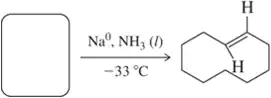
Suggest alkynes that might be used to make the following trans-alkenes.
(a) Chemical reaction diagram showing sodium and liquid ammonia converting a compound into a trans-alkene at -33°C.

Verified step by step guidance
1
Step 1: Understand the problem. The goal is to identify alkynes that can be used to synthesize trans-alkenes. This typically involves a reduction reaction where an alkyne is selectively reduced to a trans-alkene using reagents like sodium in liquid ammonia (Na/NH₃).
Step 2: Recall the mechanism of alkyne reduction to trans-alkenes. Sodium in liquid ammonia reduces alkynes by donating electrons, forming a radical intermediate, which then undergoes protonation to yield a trans-alkene. This reaction is stereoselective, favoring the trans configuration.
Step 3: Analyze the structure of the desired trans-alkene. Identify the carbon chain length and the position of the double bond in the trans-alkene. This will help determine the structure of the starting alkyne.
Step 4: Suggest possible alkynes. For example, if the trans-alkene has a double bond between C2 and C3, the corresponding alkyne would be an alkyne with a triple bond between C2 and C3. Use the general formula for alkynes, R-C≡C-R', where R and R' are substituents or hydrogen atoms.
Step 5: Verify the suitability of the suggested alkyne. Ensure that the alkyne can undergo reduction using Na/NH₃ to yield the desired trans-alkene. Consider steric and electronic factors that might influence the reaction outcome.

Verified video answer for a similar problem:

This video solution was recommended by our tutors as helpful for the problem above.
Video duration:
4m
Was this helpful?

Key Concepts

Here are the essential concepts you must grasp in order to answer the question correctly.

Alkynes

Alkynes are hydrocarbons that contain at least one carbon-carbon triple bond. They are unsaturated compounds and are represented by the general formula CnH2n-2. Alkynes can undergo various reactions, including addition reactions, which are crucial for synthesizing other organic compounds, such as alkenes.
Recommended video:
Guided course
09:11
Alkyne Hydration

Trans-Alkenes

Trans-alkenes are a type of alkene where the substituents on the double bond are on opposite sides, leading to a more stable configuration due to reduced steric strain. The geometric isomerism in alkenes is significant in organic chemistry, as it affects the physical and chemical properties of the compounds.
Recommended video:
3:04
Alkene Metathesis Example 2

Elimination Reactions

Elimination reactions involve the removal of atoms or groups from a molecule, resulting in the formation of a double bond. In the context of synthesizing trans-alkenes from alkynes, a common method is the partial hydrogenation of alkynes or the elimination of a leaving group from a precursor compound, which can yield the desired trans configuration.
Recommended video:
Guided course
00:40
Recognizing Elimination Reactions.