Ch. 10 - Alkynes: Electrophilic Addition and Redox Reactions
Mullins - Organic Chemistry: A Learner Centered Approach 1st Edition
Mullins1st EditionOrganic Chemistry: A Learner Centered ApproachISBN: 9780137566471Not the one you use?Change textbook
Chapter 9, Problem 3

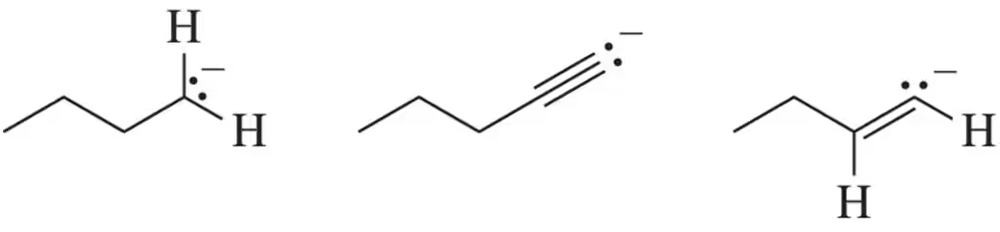
Rank the reactivity of the following anions with a general electrophile from least to most reactive.
Structural representations of anions with varying reactivity towards electrophiles, showing bonds and lone pairs.

Verified step by step guidance
1
Step 1: Understand the concept of nucleophilicity. Nucleophilicity refers to the ability of a species (anion in this case) to donate a pair of electrons to an electrophile. Factors such as charge, electronegativity, steric hindrance, and resonance stabilization influence nucleophilicity.
Step 2: Analyze the charge of each anion. Anions with a higher negative charge density are generally more nucleophilic because they have a stronger tendency to donate electrons.
Step 3: Consider electronegativity. Anions derived from less electronegative atoms are typically more nucleophilic because they hold their electrons less tightly, making them more available for donation.
Step 4: Evaluate steric hindrance. Bulky anions with large substituents may have reduced nucleophilicity due to difficulty in approaching the electrophile.
Step 5: Assess resonance stabilization. Anions that are resonance-stabilized are less reactive because their negative charge is delocalized, making them less available to interact with the electrophile.

Verified video answer for a similar problem:

This video solution was recommended by our tutors as helpful for the problem above.
Video duration:
4m
Was this helpful?

Key Concepts

Here are the essential concepts you must grasp in order to answer the question correctly.

Nucleophilicity

Nucleophilicity refers to the ability of a species to donate an electron pair to an electrophile, forming a new bond. Anions, which are negatively charged, typically exhibit higher nucleophilicity due to their excess electrons. Factors influencing nucleophilicity include charge, electronegativity, and solvent effects, with stronger bases generally being more nucleophilic.
Recommended video:
Guided course
08:27
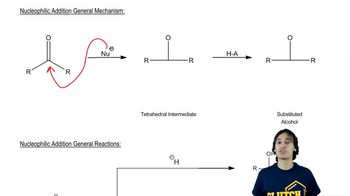
Nucleophilic Addition

Electrophiles

Electrophiles are species that accept electron pairs from nucleophiles during chemical reactions. They are usually positively charged or neutral molecules with an electron-deficient atom. Understanding the nature of electrophiles is crucial, as their reactivity can vary based on their structure and the presence of electron-withdrawing or donating groups.
Recommended video:
Guided course
03:
Nucleophile or Electrophile

Reaction Mechanisms

Reaction mechanisms describe the step-by-step process by which reactants transform into products, including the movement of electrons. Analyzing mechanisms helps predict the reactivity of anions with electrophiles, as it reveals the intermediates and transition states involved. Knowledge of common mechanisms, such as nucleophilic substitution or addition, is essential for ranking reactivity.
Recommended video:
Guided course
02:16
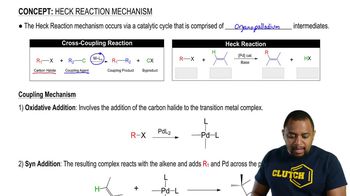
Heck Reaction Mechanism