Ch. 10 - Alkynes: Electrophilic Addition and Redox Reactions
Mullins - Organic Chemistry: A Learner Centered Approach 1st Edition
Mullins1st EditionOrganic Chemistry: A Learner Centered ApproachISBN: 9780137566471Not the one you use?Change textbook
Chapter 9, Problem 22c

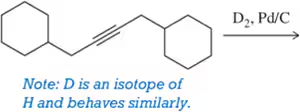
Predict the product of the following hydrogenation reactions.
(c) Chemical structure showing alkyne hydrogenation with D2 and Pd/C, noting D as an isotope of H.

Verified step by step guidance
1
Identify the type of reaction: Hydrogenation is a reaction where hydrogen (H₂) or its isotope (D₂) is added across a double or triple bond in an alkene or alkyne, converting it into a saturated compound (alkane). This reaction typically requires a metal catalyst such as Pd, Pt, or Ni.
Analyze the starting material: Determine the structure of the compound undergoing hydrogenation. Look for the presence of double or triple bonds, as these are the sites where hydrogen (or deuterium) will add.
Determine the stereochemistry: If the starting material is an alkene, the addition of hydrogen (or deuterium) occurs in a syn fashion, meaning both hydrogen atoms add to the same side of the double bond. This is due to the surface interaction with the metal catalyst.
Predict the product: Replace the double or triple bond in the starting material with single bonds, and add the appropriate number of hydrogen (H) or deuterium (D) atoms to the carbons that were part of the unsaturated bond. Ensure the product is fully saturated.
Verify the isotopic labeling: If D₂ is used instead of H₂, ensure that deuterium atoms (D) are added to the product instead of hydrogen atoms. This will result in a product where the added atoms are isotopically labeled with D.

Verified video answer for a similar problem:

This video solution was recommended by our tutors as helpful for the problem above.
Video duration:
2m
Was this helpful?

Key Concepts

Here are the essential concepts you must grasp in order to answer the question correctly.

Hydrogenation

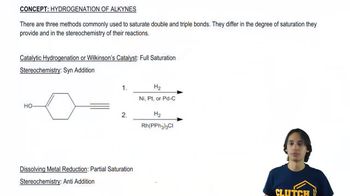
Hydrogenation is a chemical reaction that involves the addition of hydrogen (H2) to an unsaturated compound, typically an alkene or alkyne, converting it into a saturated compound. This process is commonly facilitated by catalysts such as palladium, platinum, or nickel. Understanding hydrogenation is crucial for predicting the products of reactions where unsaturated hydrocarbons are transformed into saturated ones.
Recommended video:
Guided course
00:48
The definition of hydrogenation.

Isotopes

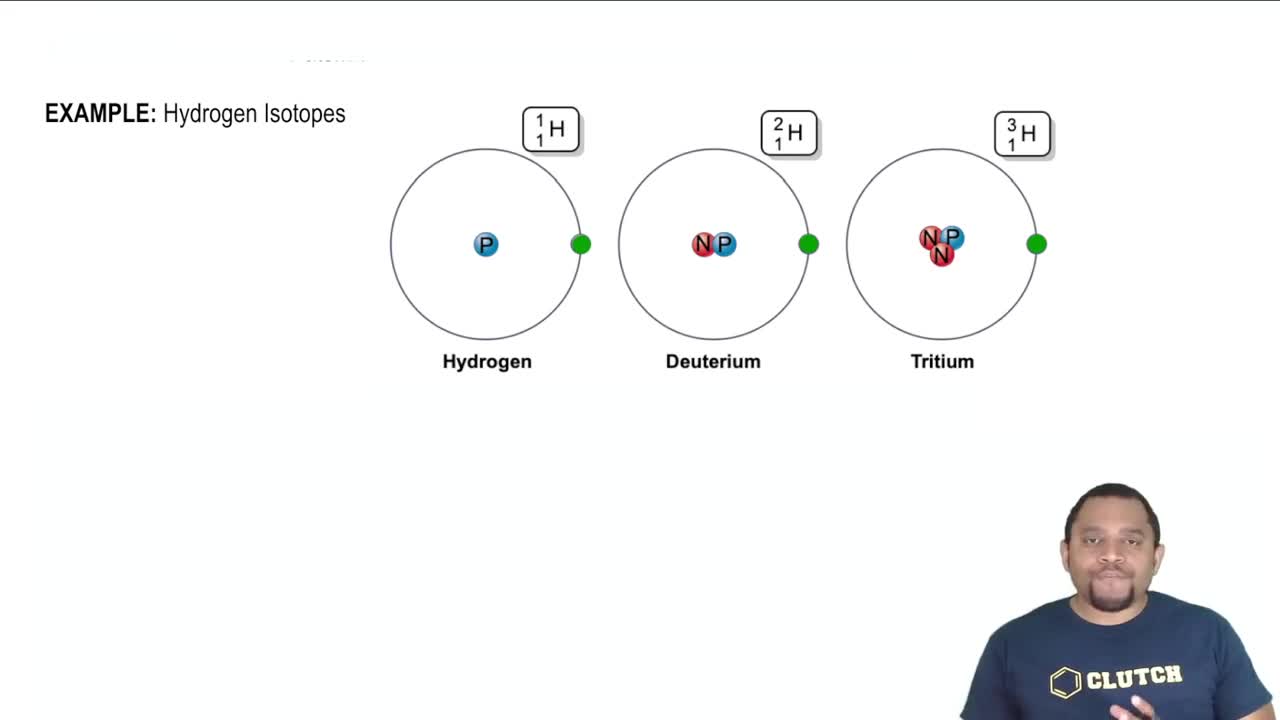
Isotopes are variants of a particular chemical element that have the same number of protons but different numbers of neutrons, resulting in different atomic masses. In the context of hydrogenation, deuterium (D) is an isotope of hydrogen (H) that can participate in reactions similarly to hydrogen. Recognizing the role of isotopes is essential for predicting reaction outcomes when they are involved.
Recommended video:
Guided course
03:06
Understanding the hydrogen isotopes.

Reaction Mechanism

A reaction mechanism is a step-by-step description of the process by which reactants are converted into products in a chemical reaction. It outlines the sequence of elementary steps, including bond formation and breaking. Understanding the mechanism of hydrogenation reactions helps in predicting the specific products formed, especially when isotopes like deuterium are involved, as they may influence the reaction pathway.
Recommended video:
Guided course
02:16
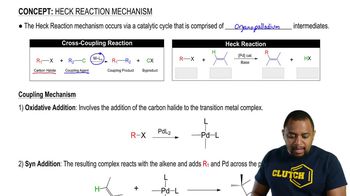
Heck Reaction Mechanism