
Ch. 10 - Alkynes: Electrophilic Addition and Redox Reactions
Mullins - Organic Chemistry: A Learner Centered Approach 1st Edition
Mullins1st EditionOrganic Chemistry: A Learner Centered ApproachISBN: 9780137566471Not the one you use?Change textbook
Chapter 9, Problem 6c

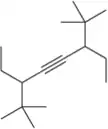
Identify the following alkynes as terminal (T), internal/symmetrical (IS), or internal/unsymmetrical (IU).
(c) Chemical structure of an alkyne with branches, indicating terminal and internal configurations.

Verified step by step guidance
1
Step 1: Recall the definitions of terminal, internal/symmetrical, and internal/unsymmetrical alkynes. A terminal alkyne (T) has the triple bond at the end of the carbon chain, with at least one hydrogen atom directly attached to one of the sp-hybridized carbons. An internal/symmetrical alkyne (IS) has the triple bond between two carbons that are symmetrically substituted. An internal/unsymmetrical alkyne (IU) has the triple bond between two carbons that are asymmetrically substituted.
Step 2: Examine the structure of the given alkyne (c). Identify the position of the triple bond within the carbon chain and determine the substituents attached to the sp-hybridized carbons.
Step 3: If one of the sp-hybridized carbons in the triple bond is bonded to a hydrogen atom, classify the alkyne as terminal (T).
Step 4: If both sp-hybridized carbons are bonded to carbon groups, check if the substituents on either side of the triple bond are identical. If they are identical, classify the alkyne as internal/symmetrical (IS).
Step 5: If both sp-hybridized carbons are bonded to carbon groups but the substituents on either side of the triple bond are different, classify the alkyne as internal/unsymmetrical (IU).

Verified video answer for a similar problem:

This video solution was recommended by our tutors as helpful for the problem above.
Video duration:
1m
Was this helpful?

Key Concepts

Here are the essential concepts you must grasp in order to answer the question correctly.

Alkynes

Alkynes are hydrocarbons that contain at least one carbon-carbon triple bond. They are unsaturated compounds, which means they have fewer hydrogen atoms than alkanes with the same number of carbon atoms. The general formula for alkynes is CnH2n-2, where n is the number of carbon atoms. Understanding the structure of alkynes is crucial for identifying their types based on their position in the carbon chain.
Recommended video:
Guided course
09:11
Alkyne Hydration

Terminal vs. Internal Alkynes

Terminal alkynes have the triple bond located at the end of the carbon chain, while internal alkynes have the triple bond between two carbon atoms within the chain. This distinction is important because it affects the reactivity and properties of the alkyne. Terminal alkynes can be converted into various functional groups through reactions, while internal alkynes often exhibit different chemical behaviors due to their structure.
Recommended video:
Guided course
02:43
Anti-Markovnikov addition of alcohols to terminal alkynes yields aldehydes

Symmetrical vs. Unsymmetrical Alkynes

Symmetrical internal alkynes have identical groups attached to both sides of the triple bond, while unsymmetrical internal alkynes have different groups on either side. This classification is significant for predicting the outcomes of chemical reactions and understanding the physical properties of the compounds. Recognizing the symmetry in the structure helps in determining the reactivity and potential isomerism of the alkyne.
Recommended video:
Guided course
09:11
Alkyne Hydration