Ch. 10 - Alkynes: Electrophilic Addition and Redox Reactions
Mullins - Organic Chemistry: A Learner Centered Approach 1st Edition
Mullins1st EditionOrganic Chemistry: A Learner Centered ApproachISBN: 9780137566471Not the one you use?Change textbook
Chapter 9, Problem 24b

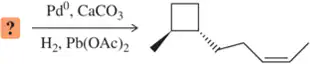
Hydrogenation of which alkynes would produce the following cis-alkenes?
(b) Chemical reaction diagram showing hydrogenation conditions for producing cis-alkenes from alkynes.

Verified step by step guidance
1
Step 1: Analyze the reaction conditions provided in the image. The reagents include Pd⁰ (Palladium catalyst), CaCO₃ (calcium carbonate), H₂ (hydrogen gas), and Pb(OAc)₂ (lead acetate). These are the typical components of the Lindlar catalyst, which is used for selective hydrogenation of alkynes to cis-alkenes.
Step 2: Understand the product structure shown in the image. The product is a cis-alkene with a cyclobutyl group attached to a chain containing a double bond. The stereochemistry of the double bond is cis, meaning both substituents are on the same side of the double bond.
Step 3: Recall that the Lindlar catalyst selectively hydrogenates alkynes to cis-alkenes without further reducing the alkene to an alkane. Therefore, the starting material must be an alkyne that corresponds to the product structure.
Step 4: Deduce the structure of the alkyne precursor. To form the cis-alkene shown, the alkyne must have the same carbon skeleton as the product, but with a triple bond in place of the double bond. The triple bond should be located where the double bond is in the product.
Step 5: Write the structure of the alkyne precursor. Replace the cis double bond in the product with a triple bond, ensuring the rest of the molecule remains unchanged. This alkyne, when subjected to the Lindlar catalyst, will produce the given cis-alkene.

Verified video answer for a similar problem:

This video solution was recommended by our tutors as helpful for the problem above.
Video duration:
2m
Was this helpful?

Key Concepts

Here are the essential concepts you must grasp in order to answer the question correctly.

Hydrogenation of Alkynes

Hydrogenation is a chemical reaction that involves the addition of hydrogen (H2) to an unsaturated compound, such as an alkyne, to convert it into a saturated compound, like an alkene or alkane. In the case of alkynes, the reaction can yield cis-alkenes when specific catalysts and conditions are used, such as using Lindlar's catalyst, which selectively hydrogenates alkynes to cis-alkenes.
Recommended video:
Guided course
03:46
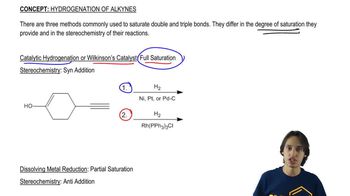
Using Catalytic hydrogenation or Wilkinson’s Catalyst to turn alkynes to alkanes.

Lindlar's Catalyst

Lindlar's catalyst is a palladium-based catalyst that is used to facilitate the partial hydrogenation of alkynes to cis-alkenes. It consists of palladium (Pd) deposited on calcium carbonate (CaCO3) and is often poisoned with lead acetate (Pb(OAc)2) to prevent complete hydrogenation to alkanes. This selective hydrogenation is crucial for producing specific stereoisomers in organic synthesis.
Recommended video:
2:10
Introduction to Catalysis Concept 1

Stereochemistry of Alkenes

Stereochemistry refers to the spatial arrangement of atoms in molecules and how this affects their chemical behavior. In the case of alkenes, the cis and trans configurations arise from the restricted rotation around the double bond. Understanding the stereochemistry is essential for predicting the properties and reactivity of the resulting alkenes from hydrogenation reactions, particularly in the context of synthesis and biological activity.
Recommended video:
1:38
Polymer Stereochemistry Concept 1