Ch. 10 - Alkynes: Electrophilic Addition and Redox Reactions
Mullins - Organic Chemistry: A Learner Centered Approach 1st Edition
Mullins1st EditionOrganic Chemistry: A Learner Centered ApproachISBN: 9780137566471Not the one you use?Change textbook
Chapter 9, Problem 41c

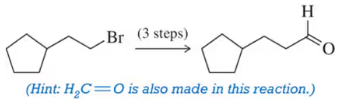
Beginning with the molecules on the left of each chemical equation, synthesize the molecules shown. While there can be multiple ways of doing each synthesis, the minimum number of steps necessary is indicated over each reaction arrow.
(c)

Verified step by step guidance
1
Step 1: Perform an elimination reaction on the starting molecule (cyclopentylmethyl bromide) to form an alkene. Use a strong base, such as potassium tert-butoxide, to remove the bromine atom and generate cyclopentylmethyl alkene (CH2=CH-cyclopentane).
Step 2: Carry out an ozonolysis reaction on the alkene formed in Step 1. Use ozone (O3) followed by a reducing agent like dimethyl sulfide (DMS) or zinc in acetic acid to cleave the double bond and form two products: formaldehyde (H2C=O) and cyclopentylacetaldehyde.
Step 3: Oxidize the aldehyde group in cyclopentylacetaldehyde to a ketone. Use a mild oxidizing agent such as PCC (pyridinium chlorochromate) or a stronger oxidizing agent like Jones reagent (CrO3/H2SO4) to convert the aldehyde to cyclopentylacetone.

Verified video answer for a similar problem:

This video solution was recommended by our tutors as helpful for the problem above.
Video duration:
4m
Was this helpful?

Key Concepts

Here are the essential concepts you must grasp in order to answer the question correctly.

Synthesis in Organic Chemistry

Synthesis in organic chemistry refers to the process of constructing complex organic molecules from simpler ones through a series of chemical reactions. Understanding the synthesis pathway is crucial, as it involves selecting appropriate reagents and conditions to achieve the desired product efficiently. Each step in the synthesis must be carefully planned to minimize the number of reactions while maximizing yield.
Recommended video:
Guided course
00:56
What is an organic molecule?

Reaction Mechanisms

A reaction mechanism describes the step-by-step sequence of elementary reactions by which overall chemical change occurs. It provides insight into how reactants transform into products, including the formation and breaking of bonds. Familiarity with common mechanisms, such as nucleophilic substitution or elimination, is essential for predicting the outcomes of synthetic routes.
Recommended video:
Guided course
02:16
Heck Reaction Mechanism

Functional Groups

Functional groups are specific groups of atoms within molecules that are responsible for the characteristic chemical reactions of those molecules. Recognizing functional groups is vital for understanding reactivity and guiding synthesis, as different groups can dictate the types of reactions that can occur. For example, carbonyl groups (C=O) are key in many synthesis pathways, including the formation of aldehydes and ketones.
Recommended video:
Guided course
02:36
Identifying Functional Groups