Ch. 9 - Substitution and Elimination Reactions of Alkyl Halides
Bruice - Organic Chemistry 8th Edition
Bruice8th EditionOrganic ChemistryISBN: 9780135213711Not the one you use?Change textbook
Chapter 10, Problem 14c

Which substitution reaction takes place more rapidly?
c. Chemical equation showing substitution reactions in ethanol with CH3CH2Cl, CH3O−, and CH3S−.

Verified step by step guidance
1
Step 1: Understand the type of substitution reaction involved. Both reactions are nucleophilic substitution reactions, where the nucleophile (CH3O− or CH3S−) attacks the electrophilic carbon in CH3CH2Cl, displacing the leaving group (Cl−).
Step 2: Compare the nucleophiles. CH3O− is an alkoxide ion, while CH3S− is a thiolate ion. Thiolate ions are generally more nucleophilic than alkoxide ions because sulfur is larger and more polarizable than oxygen, making CH3S− a stronger nucleophile.
Step 3: Consider the solvent. The solvent ethanol is protic, meaning it can form hydrogen bonds. Protic solvents tend to stabilize smaller, more basic nucleophiles like CH3O−, reducing their nucleophilicity. Thiolate ions (CH3S−), being less basic and more polarizable, are less affected by protic solvents and retain their high nucleophilicity.
Step 4: Evaluate the leaving group and substrate. CH3CH2Cl is a primary alkyl halide, which is favorable for SN2 reactions. In SN2 reactions, the rate depends on both the nucleophile and the substrate. Since CH3S− is a stronger nucleophile, the reaction with CH3S− will proceed more rapidly.
Step 5: Conclude based on the comparison. The substitution reaction involving CH3CH2Cl + CH3S− in ethanol will take place more rapidly than the reaction involving CH3CH2Cl + CH3O− due to the higher nucleophilicity of CH3S− in a protic solvent.

Verified video answer for a similar problem:

This video solution was recommended by our tutors as helpful for the problem above.
Video duration:
4m
Was this helpful?

Key Concepts

Here are the essential concepts you must grasp in order to answer the question correctly.

Nucleophilicity

Nucleophilicity refers to the ability of a nucleophile to donate an electron pair to an electrophile during a chemical reaction. In this context, CH3O− (methoxide) and CH3S− (thiolate) are both nucleophiles, but their reactivity can differ based on factors such as charge, electronegativity, and solvent effects. Generally, stronger nucleophiles react more rapidly in substitution reactions.
Recommended video:
Guided course
08:27
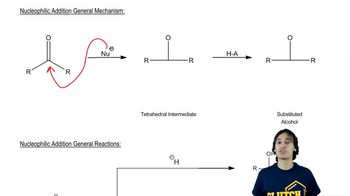
Nucleophilic Addition

Substitution Reactions

Substitution reactions involve the replacement of one functional group in a molecule with another. In organic chemistry, these reactions can be classified as either nucleophilic substitution (S_N1 or S_N2 mechanisms) depending on the structure of the substrate and the nature of the nucleophile. The rate of these reactions is influenced by the strength of the nucleophile and the leaving group.
Recommended video:
Guided course
01:34
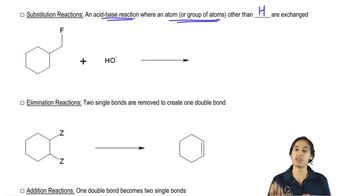
Recognizing Substitution Reactions.

Solvent Effects

The choice of solvent can significantly impact the rate of substitution reactions. Polar protic solvents, like ethanol, can stabilize ions and influence the nucleophilicity of the reactants. For example, in a polar protic solvent, nucleophiles may be less reactive due to solvation effects, which can affect the overall reaction rate and mechanism.
Recommended video:
Guided course
01:16
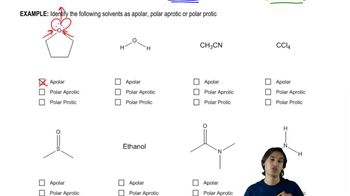
Identification of polarity in solvents