Ch. 9 - Substitution and Elimination Reactions of Alkyl Halides
Bruice - Organic Chemistry 8th Edition
Bruice8th EditionOrganic ChemistryISBN: 9780135213711Not the one you use?Change textbook
Chapter 10, Problem 25c,d

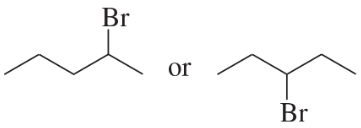
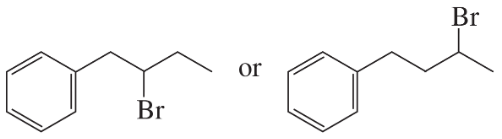
Which alkyl halide in each pair is more reactive in an E2 reaction with hydroxide ion?
c.
d.

Verified step by step guidance
1
Step 1: Understand the E2 reaction mechanism. E2 reactions are bimolecular elimination reactions where a base removes a proton from a β-carbon, and a leaving group (such as Br) departs simultaneously, forming a double bond.
Step 2: Analyze the first pair of alkyl halides. The reactivity in E2 reactions depends on the ability of the β-hydrogen to be abstracted and the stability of the resulting alkene. The first structure is a secondary alkyl bromide, while the second structure is a primary alkyl bromide. Secondary alkyl halides are generally more reactive in E2 reactions due to the formation of a more stable alkene.
Step 3: Analyze the second pair of alkyl halides. Both structures contain a benzene ring, which can stabilize the resulting alkene through conjugation. The first structure has the bromine attached to a secondary carbon, while the second structure has the bromine attached to a primary carbon. The secondary alkyl bromide is more reactive in E2 reactions due to the stability of the alkene formed.
Step 4: Consider steric hindrance. In E2 reactions, steric hindrance around the β-hydrogen can affect the reaction rate. Secondary alkyl halides typically have less steric hindrance compared to tertiary alkyl halides, making them more reactive.
Step 5: Summarize the findings. For the first pair, the secondary alkyl bromide is more reactive. For the second pair, the secondary alkyl bromide attached to the benzene ring is more reactive due to the stabilization provided by conjugation with the aromatic ring.

Verified video answer for a similar problem:

This video solution was recommended by our tutors as helpful for the problem above.
Video duration:
9m
Was this helpful?

Key Concepts

Here are the essential concepts you must grasp in order to answer the question correctly.

E2 Reaction Mechanism

The E2 (bimolecular elimination) reaction is a type of elimination reaction where a base removes a proton from a β-carbon while a leaving group departs from the α-carbon simultaneously. This concerted mechanism results in the formation of a double bond. The strength of the base and the structure of the alkyl halide significantly influence the reaction rate and outcome.
Recommended video:
Guided course
09:36
Drawing the E2 Mechanism.

Alkyl Halide Reactivity

The reactivity of alkyl halides in E2 reactions is influenced by steric hindrance and the nature of the leaving group. Generally, tertiary alkyl halides are more reactive than secondary, which are more reactive than primary halides due to steric factors that affect the accessibility of the β-hydrogen to the base. A better leaving group also enhances reactivity.
Recommended video:
Guided course
01:52
How to name alkyl halides

Role of Hydroxide Ion

Hydroxide ion (OH-) is a strong base commonly used in E2 reactions. Its ability to abstract a proton from the β-carbon is crucial for the elimination process. The strength of the base can affect the reaction pathway, and in the presence of a strong base like hydroxide, the E2 mechanism is favored over substitution reactions.
Recommended video:
3:39
Metal Ion Catalysis Concept 1